Twitter and I. Our first Anniversary


Not Love at First Sight

I met Twitter for the first time a year ago today.  I was not particularly impressed after our first interaction. I don’t think Twitter was either. It did not talk back to me.

I could not have predicted then that a year later it would take such an important role in my work, the way I learn, how I interact with the world.

Like Direct Interaction

Twitter is the communication medium that most closely models direct human interaction in the real-world. Better than any other media we used in the past.

  • You can say anything you want. Want to express your political views? Tell the world what you had for dinner? There is a tweet for that. You have open access to the medium.
  • Want people to listen to what you say? That is a different story. You must be interesting. There is no guarantee that anything you say will be heard or even acknowledged. It is a recipient-discretion medium.
  • Like in the real world, you can communicate more effectively if you make the effort to build a relationship first. Communication is personal again.
  • If you are really smart, you can talk without listening. But that will only take you so far. Like in real conversation, others have an opportunity to respond and influence your thoughts in real-time, as you articulate your ideas.

Difficult but Rewarding

It is not an easy relationship. I have been trained to use the print medium to learn and express knowledge. I am not used to give people the opportunity to react to my arguments before I have polished and made them unassailable. I grew up thinking I should be introspective, read about what I don’t and write about what I do know, not that I should learn by interacting and co-creating new ideas with others.

But I am growing more comfortable not depending on the classic protocols (“You should know, I sent you an e-mail yesterday”). My views are more ephemeral, not based exclusively on my analysis, but sensitive to the ideas of people I interact with. I am happy with this different way of learning.

Loving it the way it is

I love Twitter the way it is, as a transport medium for interaction. The accidental 140-characters post size (which, the story goes, was set to make it SMS-friendly) imposes the limits that keeps it simple and general-purpose.

But I don’t think direct use of Twitter will ever become mainstream. Even the early adopters of Twitter today don’t do it. I happen to use Hootsuite, which is still a very primitive interaction tool above the Twitter transport layer.

The risk is that the makers of Twitter need to transform it from a communication platform into an interaction tool because of the pressures of survival as a company.

I’ve written about this before (“The Twitterfeed is Dead“). Let others develop new front end applications. Social CRM vendors are applying Twitter feeds to business processes. Paper.li and Flipboard are creating automated curation tools. Tweetdeck and equivalents are creating dashboards for Social Media professionals. We are just starting in that wave of innovation.

I suppose Twitter (the company) is thinking hard how to make Twitter (the platform) viable and sustainable in the long-term. But I think we, loving users of Twitter, have to think about that as well.

It is our first anniversary. Of many others to come.

Focus on Mission, Deliver Customer Experience


I have recently written about how moving to a social business model requires us to shift our thinking on metrics and accountability. My argument has been that metrics need to reflect the real business impact (the example was Customer Service being credited for new business because it was result of referrals by happy customers).

But partial metrics and extrinsic incentives (goal setting, management by objectives, accountability) is not the best way to coax workers to perform knowledge-based tasks (i.e. anything that requires more than just motor skills) and deliver what customers need. There is a great TED talk by Dan Pinker (via @berkson0)on that specific subject.

So how are we going to drive business with less reliance on analytical metrics and personal accountability?

The Customer Perspective

I once heard Michael Fauscette (from IDC) use this example during a conference session. He asked “What is the mission of an airline carrier?” Is it to fly airplanes? Is it to fly airplanes on schedule? Is it to fly airplanes as efficiently as possible?

Yes, airlines do those things every day, but they are internal aspects of the business. The true mission of airlines (from a customer’s perspective) is to offer safe and comfortable transportation from point A to point B. The true measure of the business is the quality of the air traveller’s experience.

Zappo’s, the online shoe retailer (now part of Amazon.com) became a reference for good customer experience. It understood that it is not in the shoe business (they don’t design or make them, their shoes are the same you can find in other stores). Zappo’s business is to create an environment where I can select and buy shoes and then have them delivered to me, in a stress-free shopping experience.

So tell me, What is new?

I can see the rolling eyes, we have heard all the above before. Why do we need to keep talking about it?

The reason: most businesses, including successful ones, fail that test.

We grew accustomed to decomposing the mission and assigning partial goals to people in our organization. We went too far on segmentation and specialization. A front-line agent who doesn’t know or worries about internal metrics cannot stay focused on the customer experience.

The broad adoption of Social Media by consumers and business in the next years will bring a world where new customers are acquired through indirect (mediated by social media venues) or direct (like in the old times) word-of-mouth and referrals from happy customers instead of traditional broadcasting marketing methods.

The Customer Experience (and perspective) will matter more

So to survive, companies will need to focus on their essential mission (from the perspective of their customers) and empower their employees to deliver it well. Happy customers bring their friends. You need to know who they are and what they want to keep them happy.

Does everyone in your organization know what it is that customers want from your company? Are employees emotionally involved in delivering on the mission?

They better be. The world is changing.

2010 in review


This is an automated analysis of my blogging at MarcioSaito.com in 2010.

The stats helper monkeys at WordPress.com mulled over how this blog did in 2010, and here’s a high level summary of its overall blog health:

Healthy blog!

The Blog-Health-o-Meter™ reads Fresher than ever.

Crunchy numbers

Featured image

A Boeing 747-400 passenger jet can hold 416 passengers. This blog was viewed about 2,100 times in 2010. That’s about 5 full 747s.

In 2010, there were 70 new posts, growing the total archive of this blog to 73 posts. There were 121 pictures uploaded, taking up a total of 15mb. That’s about 2 pictures per week.

The busiest day of the year was May 19th with 56 views. The most popular post that day was The World Has Changed – Evolve Video.

Where did they come from?

The top referring sites in 2010 were facebook.com, twitter.com, linkedin.com, hootsuite.com, and mail.yahoo.com.

Some visitors came searching, mostly for caipirinha, good metaphors, marcio saito, terere, and tereré.

Attractions in 2010

These are the posts and pages that got the most views in 2010.

1

The World Has Changed – Evolve Video May 2010

2

Making Caipirinha August 2010

3

Good Metaphors are Truth October 2010
6 comments

4

Drinking Tereré July 2010
3 comments

5

Climbing Mt. Shasta May 2010

Social SMB – Be more Open in 2011


The adoption of Social Business models has to start from the inside-out.

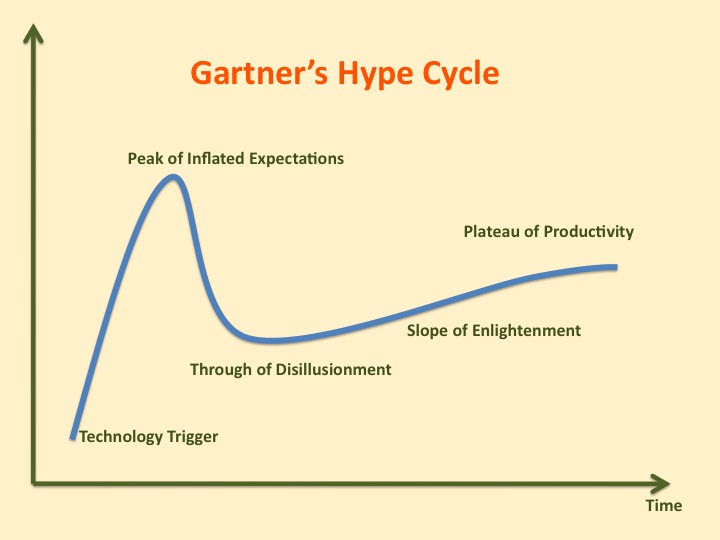
As we get to the last days of 2010, we need to recognize that this was the year we reached peak of  inflated expectations for Social-Everything.

Small and mid-sized companies were told they needed to use Social Media and many went on to set their Facebook pages and Twitter accounts and hire a “Social Media Manager” invariably with not great results.

What should we expect in the next years? Disillusionment. Expect people to say: “Social was a fad, it has no use in Business”.

Gartner has modeled that market dynamics in its “Hype Cycle”.

But Social is for Real

The classical business models have been the most efficient because they relied on analysis and segmentation, reducing dependencies and the need for collaboration, focusing on functional and personal accountability to solve complex problems.

The adoption of Social Technologies will change the way we do business. How? By reducing the friction (and cost) of collaboration, it will enable the emergence of new business models that will better leverage the synergy in people’s interactions (both within and outside the organization).

Business changes associated with Social Technologies are slow and gradual because they mirror behavioral changes that are generational to a large degree (see The Click Company– Adapt or Die). But that generational change has already happened and we are just seeing its unraveling as a new generation become active consumers and take decision-making positions in business.

So, What Should SMB do?

How should your company face the changes resulting from the adoption of social technologies in business? Here are some ideas:

  • Focus on the inside first. An organization cannot be social in its interaction with customers and the market if it is not open on the inside. Break the knowledge silos, promote transparency, empower employees. Turn your company into an open, collaborative organization.
  • Fundamentals of marketing and sales don’t go away because of a new media. The transition from traditional media (print, e-mail, broadcast, etc) to social media will happen over the next several years. What you read about Social Media is true (and you will need a Facebook Page), but we need to be in it for the long run.
  • Social CRM does not invalidate traditional Customer Relationship Management strategies, but it is a profound transformation. CRM processes and tools will evolve at first, and they must transform. Some established tool vendors will adapt, others will miss the transition and die. New emerging vendors will bring innovation and carve a space.
  • The time to embrace change, invest in research, and find the right partners for the journey ahead is now. The time to execute your strategies extends for the next several years. Don’t slow down as inflated expectations subside, because they will.

… And Happy New Year

2011 is an important year for us at Coffee Bean. We started switching several of the early adopters of our solution into production during this last couple of months. It is time for us to deliver value to our customers.

I think this blog will mirror that transition by narrowing its focus on the SMB and moving from thought to action.

Thank you for supporting us in 2010. I’ve learned a lot by interacting with you here and in our conversations in Social Media. I believe we live very interesting times.

Be 2011 a great year for all of us.

Agile Professional Services?


Professional Services is clearly not my area of expertise (I have not been a contract-based service provider first hand) but I enjoy participating in the #ProfServ Twitter Chat led by @KRCraft @Berkson0 and @fredmcclimans (bi-weekly, next Dec 23rd 10PM EST).

In the last chat a week ago, I was hearing about the challenges contractors and service providers face in defining and managing scope and billing customers. Service Providers need to limit the amount of “free consulting” and then be careful defining the acceptance criteria of the project. Customers worry about escalating hours/costs and false “success” that does not deliver the business benefits. That difference in perspective also manifests in the conflict between Time&Materials or Fixed price models.

It is not too difficult to see that the issue is the same software companies face internally: The engineering department provides service, the product marketing department is the internal “customer”. Engineering never knows how much time a project requires and Marketing never knows the true market requirements in advance. Yet both pretend they know everything, sign up for very detailed  and structured 12-month product development plans. And fail miserably.

The Agile software development process emerged in its current form as incremental software development methods as the pendulum moved from the ad-hoc methods of the 70’s and  80’s to the extreme ISO9000-like planning of the 90’s and back. The Agile Manifesto came out in 2001.

I was sure it was not a new idea, but I thought: “Does it make sense to think about Agile Professional Services?”

After some time in Google, I am surprised that, though it is indeed not a new idea, it is under-explored. I haven’t been able to find good articles or material exploring the extension of Agile processes outside an organization.

My bullet-level description of an agile process (not necessarily the “A”gile Process) is:

  • People, interactions, working systems, embracing of constant change are more important than processes, tools, documentation, plans.
  • Partnership and mutual trust are essential. Communicate constantly, and at least daily without exception. Easy to say, hard to practice.
  • It is important to share a vision, the notion of success, and understand who the user is.
  • Don’t pretend you know every step of where and how. Agree on the direction, establish short-term incremental goals. Slides, plans, ideas are not acceptable deliverables. You must get to something incremental but tangible and demonstrable.
  • Execute, Evaluate, Adjust based on user feedback in quick iterations (in SW development, that means “Sprints” of 2-4 weeks).
  • Jointly measure actual progress and use that to plan the next iteration.
  • Rinse, Repeat.

I don’t really know how to translate it to the Professional Service world. Maybe, it would mean something like (a) establish trust and common vision, (b) run a sequence of incremental fixed-scope, fixed-price iterations grouped into a larger open scope that evolves as the project takes form.

Even in the software development area today, when a project is contracted to external organizations, we tend to gravitate towards fixed scope/price, traditional project management, not agile. The communication requirements of an agile process are difficult to implement with external parties.

So the question remains: Does Agile Professional Services make sense?

Social Media: The Impact on Customer Surveys


Asking for Customer Feedback is different from Listening

Last night, I was in the Customer Service Twitter chat that happens every Tuesday at 10PM PST. I truly recommend this lively, fun, and insightful conversation to anyone interested in Customer Service.

Yesterday’s discussion was: “Do surveys after a Customer Service incident improve the customer relationship?“. Here are some my thoughts and a collection of insights from the discussion.

If you are going to ask, ask it right.

Short of direct interaction at the point of delivery/intervention, if the communication medium available to you is the printed word, satisfaction surveys are really the only tool you have to collect post-experience feedback.

All classical recommendations about customer surveys are still valid and many chat participants reminded us: Keep it simple and short, apply the survey soon after the experience, provide acknowledgement and act on feedback, etc.

But the problems and limitations of surveys are also valid, no matter how good they are: extra burden on customers, reactive mechanism, almost always biased.

@rgmarkey: The more you structure feedback w/closed questions, the less sure you are customer is telling you what’s important #custserv


Social Media: Stop asking, start listening

About a year ago, I was at a conference and the Social Media Director for the MGM Grand said:

We monitor Social Media because the first thing a guest does when finding a problem is to talk about it in Twitter or Facebook. I need to know she is unhappy about the service at the restaurant and turn it around before she checks out of my hotel. That makes the difference between 50 other people hearing about how terrible or how wonderful my service is.  I couldn’t do that with satisfaction surveys.

I think that quote distills the impact of Social Media in Customer feedback collection:

  • It is no longer about prompting customers to evaluate their experience, but listening for customer feedback where they dispense it. Twitter and Facebook are the obvious places, but it could be Yelp if you own a small local service business, or a specialized forum if you are in B2B.
  • It is real-time and it is about the current experience and making it a good one, not learn how bad it was so that you can fix it for the next customer. You cannot afford a dissatisfied customer negatively influencing others.
  • It is personal, not statistical. You want to make each customer’s experience as good as it can be. The days of  improving the “average customer experience” so that “more than 50% strongly agree it was satisfactory” are gone. There is no such a thing as average satisfaction.
  • Don’t ask, just fix it. Happy customers will bring you their friends.

The principles of Customer Satisfaction are and will remain the same. Providing good customer experience is still the best way to bring new customers.

The impact of social media is the ability to get feedback without being intrusive and, for most businesses, to shorten the time between awareness and action so that we can fix customer experiences before they become bad experiences.

Social LeadGen for Real-World SMB Marketers


When we read about the impact of Social Media in Marketing, we see mostly one of two extremes:

  • Social Media is just another media (nothing changes) or;
  • Social Media changes Marketing (everything changes)

We live in the real world. So, what is the impact of Social Media in Lead Generation programs for SMB?

It is all about Media

The core difference between Social Media and Classical Media (print, broadcast, static websites) is that the latter is uni-directional. Print, Radio, Television, E-mail and early Web allowed inexpensive broadcast of messages to a large audience, but did not provide the channels for customer participation and for audience peer-to-peer interaction.

Social Media, however, can support more engagement between all participants. The media mix is moving away from Print, E-mail, static Web and towards Dynamic Web and Social Media. The shift is gradual but, because Social Media is fundamentally different, it has effects beyond a simple change of channels.

Marketing Campaigns will be smaller and more targeted

In theory, with Social Media, there is no need for discrete “campaigns”. Lead Generation is a continuous process of prompting and watching for signs of readiness. We need to engage to the external world through social media and listen.

But in the real world, we still need to execute the same proven steps we have learned over the years: select target audience, push message, listen for signals of readiness, measure and capture response, nurture, convert.

With Social Media, campaigns will be smaller, more targeted and less intrusive. A lot of the campaign execution will move closer to the sales process. Let’s see specifically how.

Defining Target Audience

The first step in running a campaign is to segment the population to target the most promising group of prospects. Traditionally, we use location, organizational title, industry segments parameters to do that.

The effect of Social Media is that it makes it possible to use more granular segmentation, possibly, all the way to the individual prospect. The Social Network, knows a lot more about people and their connections so it is not unthinkable to run campaigns targeting “prospects under the age of 30 who work at companies with less than 50 employees and are suppliers to one of our top 50 current customers and prefer Coke over Pepsi”, for example.

Broadcasting the Message

In Classical Marketing, we “broadcast our message.” In Social Marketing we “listen for signals of readiness.” But any lead generation action starts with prompting for a response.

The protocol of Social Media is one of receiver discretion (you are not expected to read everything coming through the channel), companies can communicate more often without disrupting the life of the prospects.

So the effect of Social Media is that communication is more continuous than a semi-annual business lunch and less intrusive than a monthly newsletter arriving by e-mail.

Capturing Response and Conversion

In classical marketing usually there are not many possible levels of engagement. Prospects either respond to the campaign or they don’t. With social media, there is more latitude. Customers who are interested but not yet read to initiate a sales engagement are offered options to indicate that.

In a more social environment, companies need to use technology to listen and measure the level of readiness and learn to respect the pace of customers and offer what they want when they want it.

Nurturing a prospect into a customer

While the monthly e-mail newsletter may still be applicable in some cases, Social Media create new possibilities of soft engagement that can be less intrusive and more sensitive to customer interest.

Customers can follow the company Twitter channel, or comment in the company blog or download a white paper. The nurturing process is less of a monthly pool and more of a continuous engagement.

Lead Conversion and Beyond

The conversion of a lead today tend to be a crude process of enticing customers to fill some web form. The moment you get a phone number, we assume the user is “ready”.

Social Media combined with good web analytics allow companies to “convert” a lead at the right time, so that the sales process is more natural.

After a first transaction, the work of marketing was to pursue Customer Loyalty. In the Social Business era, companies need to strive to turn happy customers in Brand Advocates and cultivate the channel to influence others.

Conclusion

Social Media does not invalidate all of the time-tested marketing process. But it is a profound transformation on how companies interact with customers. Because the media mix will not change overnight, marketers need to be aware of the effects of new media in their everyday actions.

Dia de Ação de Graças


Essa semana nos EUA onde eu moro é quando as pessoas param (o único feriado quando as coisas realmente param por essas bandas) por uma razão importante. Não estou falando do peru assado nem das liquidações nos shoping centers.

É hora de expressar Gratidão.

Gratidão é a emoção positiva nós sentimos quando recebemos um benefício. Dizer “Obrigado” é expressar essa emoção que, eu acredito, é a essência da vida em comunidade. É reconhecer o fato de que nós dependemos de outros para viver, para ser.

Se não tomarmos cuidado, começamos a usar “Obrigado” como mero protocolo social. As vezes é bom trazer o significado da expressão de volta ao consciente.

Quando penso muito, fico incomodado com nossa expressão para expressar gratidão. “Obrigado” parece dizer que “agora eu te devo alguma coisa”.

Não sou historiador ou linguista, mas minha teoria é que a expressão tem raízes em um momento histórico onde gratidão era moeda social trocada por lealdade política ou algo assim.

Em minhas andanças pelo mundo, eu sempre me interessei em saber a expressão local para expressar gratidão e a atitude social por trás da expressão.

O meu “obrigado” favorito é o da Malásia. Eles dizem “Terima Kasih”. Traduzido literalmente, significa “Receba Amor”.

Para ver como o mundo diz obrigado, aqui está uma lista de Obrigados em outras línguas.

Obrigado por ler meus artigos nesse blog e Feliz dia de Ação de Graças.

Time to Say Thank You.


This week is the time of the year when we in the US take a break from our busy lives to do something very important. No, not eating turkey and cranberry sauce. No, not researching the new gadget to buy during the Black Friday sale.

It is the time we use to express Gratitude.

Gratitude is a positive emotion we feel in acknowledgment of a benefit we have received. Saying “Thank You” is the way to express that emotion which, I believe, is the basis of life in community. It recognizes the fact that we depend on one another to live, to be ourselves.

We get used to say “Thank You” as a matter of social protocol. This is the time to bring its meaning back to consciousness.

I grew up in Brazil and my native language is Portuguese. We say “Obrigado“, which is not my favorite expression because it equals gratitude with indebtedness. Literally, it says “I owe you something”.

In my travels around the world I have always taken interest not only on the local word to express gratitude, but also on its literal meaning and the social attitude behind it.

My favorite form of “Thank You” is the one used in Malaysia. “Terima Kasih” sounds very friendly and it literally translates to “Receive Love”.

I am no historian or linguist, but I theorize that words equating gratitude and indebtedness have roots in a period in history where gratitude was used as social currency between levels of hierarchy, where favors were exchanged for political loyalty. Words that equals gratitude with love reflect a more equal exchange between peers.

I have been blogging on Social Business for about a year now. I think we are shifting from a business environment where stronger relationships are more people-to-people and less customer-to-company or people-to-expert. In Social Business, gratitude has to be more like love and less like indebtedness.

For more on Gratitude, see the article on Wikipedia (BTW, Wikipedia needs support and is asking for donations, not out of indebtedness, but true gratitude).

Here is a list to say Thank You in other languages.

Namastê (from Sanskrit), used in Nepal and India, is a salutation that roughly translates to “I honor the Spirit in you which is also in me” (“Thank You” is “Dhan-ya-vaad”). It feels to me like how the ideal Thank You should be like.

With that in mind, I would like to say Thank You for reading, agreeing or disagreeing, providing feedback and teaching me through interaction.

Happy Thanksgiving.