We get together for wine tasting once a month or so. There is usually a theme and we each bring a bottle and a dish to share.
Late last year we had a Spanish wine evening and, because I was in a brief period between jobs, I had the time to research and select all the bottles for the evening. Since them, I have continued to taste the Spanish wines I can find in California. I think they are under appreciated here and decided to put together this post.
At its worst, I think wines made of Tempranillo have a similar character as cheap Chianti wines you pick up from the bottom shelf in supermarkets. At its best, Rioja and Ribera del Duero wines made of Tempranillo are considered some of the best wines in the world.
Photo Credits: Margaret N
The line up for that night sampled the main wine regions and styles of Spanish wine: we had a Jerez Sherry, an Albariño, a pair of Riojas (wanted to compare a Crianza with a Reserve), a couple of Ribeira del Duero. I had a bottle of Cava and a couple of Priorats, which we saved for a later day. For food we had Marcona Almonds, Manchego cheese, Jamón Serrano, and several other dishes. I also tried to cook a Paella (my Spanish friends said Scallops would be a very unusual ingredient).
Spain is one the most traditional producers of wine in the world, with the largest planted area and third largest production of wine worldwide (behind Italy and France).
Tempranillo, Albariño, Garnacha, Cariñena are some of the most common grapes. Rioja is the premier wine producing region, with Ribera del Duero and Priorat also producing great wines. The region of Jerez produce Sherry (fortified wine) and Catalonia produces Cava (sparkling). Rias Baixas produces white Albariños.
Besides the use of the Tempranillo grape, Spanish wines are thought to be more “rustic” and employ more traditional wine making methods. Modernization of the industry happened later compared to other wine producing countries.
Spanish wines are often labeled by age. Crianza are young wines (aged 2 years, with at least 6 months in oak), Reserva (at least 3 years with one year in oak), Gran Reservas are produced only in above average vintages and require 5 years, with 3 years in oak. Not unusual for Spanish wines to be released only after 10+ years of aging.
Rioja reds usually are made mostly with Tempranillo, with some blending of Garnacha, Graciano and Mazuelo grapes. Rioja was influenced by Boardeaux producers in the 17th century and uses oak barrels to age wine.
Ribera del Duero is the second wine producing region, also using mostly Tempranillo grapes. Tinto Pesquera produces wines that are often among the top rated by wine experts.
Priorat is less traditional (and sometimes more innovative) and uses Garnacha and Carineña grapes.
Rias Baixas Produces the best whites from the Albariño grapes.
From Half Dome, one can see the entire Yosemite Valley
I have been to Yosemite some 30 times and climbed Half Dome a dozen times since 1994. I have mountaineering experience and the information in this post is correct to my knowledge, but it is for you to use at your own risk. If you are planning to go there and have questions, feel free to contact me by leaving a comment below.
While in Yosemite, please:
Do not feed animals (including cute ones)
Be respectful to nature and others (don’t walk in loud large groups)
Stay on marked trails unless you know what you are doing
Leave it cleaner than you found it
Climbing Half Dome in one day is a very challenging and rewarding experience. There are amazing waterfalls along the way, the thrill of climbing the Half Dome boulder, and magnificent view of the entire Yosemite Valley from the top. For most people, it is the biggest hiking/climbing accomplishment to experience and there is some pain and suffering involved.
It is not technical at all and doesn’t require previous experience or specialized equipment. Don’t “just decide” to climb Half Dome after arriving to Yosemite. Without basic preparation and good physical conditioning, a climb of Half Dome is more painful than rewarding.
When to go?
For most people, a Half Dome climb will happen from late Spring to early Fall. You want to check if the route is snow free and that the cables are up (they are usually installed after snow melts in May and removed in early in Oct). In the 2010 season, the park service implemented a requirement for an advance climbing permit.
The gateway for information about park closures, permits, and official information can be found at the National Park Service website.
Planning the climb
Unless you are in reasonable physical condition, don’t plan to climb Half Dome all the way to the top. If you have never been to Yosemite before, I also do not recommend it (you will have to rush through some of the most amazing places in the planet). It is a long and strenuous hike and there are several more reasonable goals along the way (Top of Nevada or Vernal Falls, for example).
The ideal group size for hiking/climbing is 3-6 people. Unless you know what you are doing, don’t do this alone. If you have a larger group, consider breaking it in smaller groups. Once you start, stay always in contact with your group.
Half Dome is usually done in one long day. The total round-trip distance is 14-16 miles (depending on whether you take Mist or John Muir trail). The top of Half Dome sits at 8,842 ft with total elevation gain of 4,800 ft from the Yosemite Valley floor.
To get to the trail head, you need to walk from the Curry Village day parking lot or take the shuttle. I recommend staying at Camp Curry and either walking or taking the very first shuttle of the day. You want to start from the trail head (Happy Isles) preferably before 7AM and never after 8:30AM or so.
For an average well prepared small group doing it for the first time, it will be a 12-hour journey (my personal range has been 8-12 hours). You will be sore, tired and your knees will hurt at the end of the day.
Dress up and load the Backpack
This is not a casual hike. So do not ignore the recommendation in this section.
– Start with good hiking shoes. Make sure they are sturdy enough, have been broken in. . It is possible to do it with good cross-training shoes, but tennis shoes or sandals are just not appropriate.
– You will need at the very least a full gallon of water and there is no potable water available for most of the way. My recommendation is to bring 4 1-litter bottles and reload them at the bottom of Vernal Falls both ways. I carry 6 liters.
– It is usually very hot during the day. Dress in layers and bring lightweight fleece or wind breaker tops and bottoms in your pack. Wear a hat and plenty of sunblock. The sun will be on your back most of the time.
– Bring food for the day. Don’t carry more weight than necessary. Nuts, bars, fruits, cheese, jerky are common choices.
– Carry a flashlight, you might be hiking in the dark at the end of the day. If you don’t like to get wet, make sure your wind breaker has a hood and is water-resistant (for Misty Trail).
– Bring a pair of gloves for the cables. Gardening gloves will work.
– If you are in a group with me, I will be carrying extra water, a trail map, a first-aid kit, space blanket, emergency water purification tablets.
The Climb – Happy Isles to Top of Nevada
Start from the Happy Isles trail head as early as reasonable (preferably before 7AM). Take group pictures in front of the sign with the distances to several destinations. We will be starting on the John Muir trail, which extends over Sierra Nevada all the way to Mt. Whitney.
As you start the long hike, make sure your boots are comfortable. The right time to make adjustments is before, not after, you develop blisters.
After about half hour, you will arrive at a footbridge. It is your first glimpse of Vernal Falls. Drink some water from the fountain and reload your bottles. This is also the last full-service bathroom.
Vernal Falls from footbridge
Continue on the trail and you will hit a fork. John Muir Trail continues to the right and Misty trail breaks to the left. You could reach Half Dome either way, but we will turn left and take Misty Trail (it is faster, shorter, more scenic). You will be climbing rocky steps next to the falls (if it is early summer, you will get wet).
Vernal Falls (early summer)
About 1 hour from start, you will be arriving at the top of Vernal Falls (the little dots on the photo above). Take a short break and appreciate the view. There is a composting bathroom at the Top of Vernal.
Leaving Top of Vernal Falls, cross the foot bridge and take the trail towards Nevada Falls. 15 minutes later, you get a good view of Nevada Falls to the right of the trail.
About 2 hours from start, you will be arriving at the top of Nevada Falls. Take a break. There is a composting bathroom (there are no other easy bathrooms above this one). We will save a visit to the waterfalls (quarter-mile to the right) for the way back.
If it took much more than 2 hours or you feel tired, make the Top of Nevada Falls your destination for the day. This is about 2/5 of the total climb. Turn left towards Half Dome.
The Climb – Top of Nevada to the Treeline
Shortly above Nevada Falls, you will be walking in mostly flat terrain for a while. That is Little Yosemite Valley (there is a campground, which allows for a two-day climb of Half Dome).
The trail starts to climb again through the forest. Enjoy the shade, as most of the last part of the climb will be exposed to the sun. This section of the climb is less visually dramatic, there are no waterfalls and big boulders.
About 4 hours after the start, you will reach the treeline and have the first dramatic view of Half Dome. Notice the dark line going up the boulder, you will be shortly climbing that line.
If it took much more than 4 hours to get here, it is already mid-afternoon, or you feel extremely tired, consider making this you return point.
The Climb – Final stretch: Quarter Dome and the Cables
Shortly after crossing the tree line, you will reach what some call the “quarter dome”. It is a long section of steep rock steps. It might be useful to wear gloves so you can use your hands for balance.
Over and above the steps, you will get a closer view of Half Dome and reach the beginning of the cables. Take a break. If it is late or you are afraid of heights, consider making this your point of return.
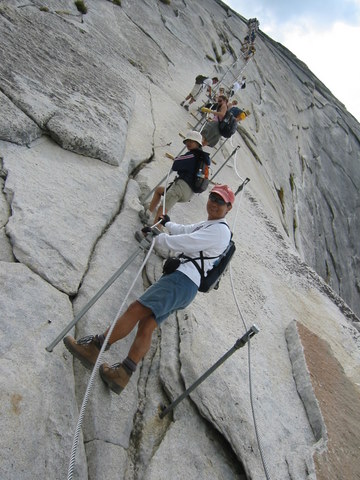
The last section of the climb is done walking on the granite boulder slope with the help of a pair of cables working as hand rails. Do not climb if there are storm clouds around you and there is risk of lightning strikes.
This may be psychologically challenging (specially on the way down), but it is not particularly difficult or dangerous. I enjoy the view, but if you are not comfortable with heights, just focus your attention to the cables and your steps.
The biggest problem you may find is traffic congestion. It is not uncommon for hikers to get stuck along the way. Be prepared to hang to the cables for up to 45 minutes waiting for the line of climbers to move.
Ok, you’ve made it. Now is time to descend back.
From the top of Half Dome you get amazing views of the Valley and dramatic vertical drops. Enjoy your accomplishment and rest for a while before starting the descend.
Most climbing injuries happen on the way down, so use caution. Adjust your boots (you want them to be snug to keep your toes from jamming). If it took you about 6 hours to reach the top, it will probably take about 4 hours down.
When you reach the bathrooms at the top of Nevada Falls, if you have time and energy, the waterfalls (1/4 mile) are well worth a visit.
From top of Nevada, there are two alternative routes. The first alternative is to return the same way up (down from the bathrooms to Vernal Falls and Misty Trail). This is my strong preference and recommendation.
The alternative is to cross the bridge at the top of Nevada Falls and go down through John Muir trail. This adds about one mile to the journey, but the descend is more gradual. The reason why some people will recommend that is that by them your knees will be hurting and the gradual slope would be gentler. I think it is just extending the pain and suffering.
Your choice.
Congratulations! You have climbed Half Dome. Hopefully, you made it to Happy Isles before sunset and before the last shuttle bus. If not, you have another mile to walk in the dark and restaurants will be closed by the time to get back to camp.
So I was born in Brazil and have lived in California for more than 20 years. I am often asked about travel in Brazil by my American friends. This post is meant to collect helpful information.
How many days I need to visit Brazil? Where to go?
Most people find surprising to learn that Brazil is larger than the continental US. So there is no way to “visit Brazil” in a few days of vacation. Because the flight from one of the US hubs (Dallas, Houston, Miami, …) to São Paulo or Rio is about 12hours, it is reasonable to plan at least a week to go anywhere in Brazil.
Most business visitors go to São Paulo. It is a cosmopolitan very large city. At its best, it feels like New York. At its worst, it can be feel like the worst in New York. Other than business, São Paulo has world-class gastronomy, culture and nightlife. Traffic is really bad.
Most tourists go to Rio. It is a large city with the problems of a large city (including crime and the shanty towns – “favelas”). But it is a beautiful place (world-famous beaches – Copacabana, Ipanema and landmarks – like the Corcovado and SugarLoaf). It is your choice to focus on the good or on the bad.
The capital cities along the Northeast coast combine beautiful beaches, a slower pace of life, historical landmarks, and a unique cultural experience.
The North of Brazil is dominated by the Amazon rainforest.
In the South, there are the majestic waterfalls of Foz do Iguaçú.
If you have less than a week, get a tour package and visit Rio or two Northeast capitals. If you have two weeks, combine Rio with either a Northeast capital or Foz do Iguaçú. If you have a lifetime…
Is it dangerous?
From a personal safety perspective, if you have traveled internationally before and/or have some common sense, not particularly. But if you wear Tevas and Flower shirts, have a camera around your neck and a Panama hat on your head and decide to walk around one of the large cities pointing at buildings, you will probably be mugged within the first 15 minutes.
From a health perspective, you will survive fine in any of the cities along the coast doing the same you do at home. If you plan to spend a week going down some remote Amazon river and visit a remote place deep in the jungle, you may want to ask your health care provider about recommended vaccinations.
So, relax. Your are on vacation.
Geography and History
Brazil is in South America. Being in the South Hemisphere, the seasons are reversed compared to the US (i.e. Christmas trees are set during summer and July is winter).
Most of the large cities in Brazil are 1 hour ahead of US EST during the US summer (i.e. noon in New York is 1PM in São Paulo) and 3 hours ahead during the US winter (daylight saving times are reversed as well).
There are no Earthquakes, Hurricanes, Snow, or any extremes in weather in Brazil. In the South and Southeast, winters are mild (temperatures don’t go below freezing). In the North/Northeast, it is always summer (but high temperatures rarely go above about 90F).
Brazil is the Latin American exception colonized by the Portuguese (your Spanish vocabulary may help, but not much). The population is about 200 million.
Brazil is a direct democracy. The president is elected directly every 4 years (as of 2015, the president is Dilma Rouseff and Brazil is in the midst of a political crisis). The country is divided into 26 states.
Culture, Dress Code
Ethnically, Brazil is a mix of the Portuguese colonizers, African slaves, and mostly Italian, Japanese, German immigrants from the early 20th Century. The South has mostly European (Italian, German) influence. The biggest cities are in the Southeast: São Paulo (where you go for business, Italian, Japanese influence) and Rio de Janeiro (Portuguese, African). The Northeast has a slower pace and a beach lifestyle, with mostly African influence. The Midwest is dominated by the “Pantanal” wetlands and the North Amazon rain forest have relatively low population density.
Brazilians are generally perceived as friendly, welcoming and warm. They will go out of their way to make sure you’re happy in their country. But don’t expect people from a large city like São Paulo to be very different from New Yorkers.
Most Brazilians dress casual, but not sloppy. They are fashion-aware. Don’t wear shorts and flower shirts in the city unless you want to stand up as a tourist.
The business culture is close enough to American. So, if you dress and behave like you do at home (unless you are from California, in which case step up a notch), you will be fine.
Most Brazilians are Roman Catholic.
Soccer is, by far, the most popular sport. Formula One racing is popular as well. Brazil usually does well in team sports (basketball, volleyball, etc).
Money, Driving and Passports
The Brazilian currency is the Real (R$). As of 2015, thinghs are shaky in the economy and US$1 = R$4. The country is on sale.
Generally, Brazil will feel inexpensive to an average American visitor. Imported articles will cost about the same as in the US (shopping mall, McDonald’s, fashionable clothing, etc). Basic necessities and services (food, taxi rides, local products, mid-range hotels, etc) will be about half of what you are used to.
Credit cards work in large cities, shopping malls and high-end restaurants, but you probably want to carry local currency. The best way to get local currency is to use your ATM card (not all ATM machines will take your US card, so you need to look for the network logos).
Nobody will complain if you tip above the nominal fee, but most restaurant checks already include a 10% service charge and it is not necessary to tip taxi drivers. For other tourist services (hotel, tour guides, etc), you can do as you would at home and you will make people happy.
Driving is similar to the US. Exception: No right turn on red. Generally, driving in Brazil is a lot more aggressive than in the US. It is easier and cheaper to get a taxi, don’t rent a car unless you know what you are doing.
US Americans need a Visa to visit Brazil. There is a reciprocity policy, so you will be treated similarly to how the US embassy treat Brazilians (expensive fees, slow service). It is a nuisance, but nothing out of the ordinary.
Food
Food is not to be experienced as a comparison, but compared to the US, Brazilian food will be generally saltier and less spicy. It will change depending on where you are, but is is not exactly “exotic”.
You will probably try fruits that are fresher and more diverse than you have ever seen anywhere else.
The “typical” food will be “Feijoada” (black beans and pork stew, served with a variety of side dishes) and “Churrasco” (cuts of meat, mostly beef, served Gaucho-style).
The everyday home food for most of Brazilians is rice, beans, beef, green salad.
In the South, food will have strong European (Italian, German) influence. Beef is good and plentiful.
São Paulo is the food capital. Cosmopolitan, with word class Italian and Japanese.
In the Northeast, you will find spicier food, more seafood and cassava (yucca) or maize as the staple starch.
Table etiquette is not very different to what you are used to. People use fork and knife to eat pizza. Otherwise, behave as you do at home and you will be fine.
There is not a big wine tradition in Brazil. Most people drink beer (usually, not very memorable Pilsen). The national liquor is “Cachaça”, made of sugar cane, similar to rum. Order a “Caipirinha” (mix of Cachaça, lime and sugar).
Tourist Destinations
In approximate order of popularity:
Rio de Janeiro. Worldclass beaches (Copacabana, Ipanema) and landmarks (Corcovado, Sugar Loaf).
Northeast. Capitals along the Coast. Salvador and Recife are the most popular. Lots of colonial history, African influences, slow pace of life, beach life.
São Paulo. Large cosmopolitan city. Business, Gastronomy, Nightlife.
Conferences need to evolve towards physical social venues
People were still arriving and Mitch Lieberman, said: “Let’s move the chairs into a circle. I am not a speaker, I am a facilitator”. He went on to get to know members of the audience. People were able to speak without having a microphone or podium separating them from vendors and experts. I was thinking: “This is how every conference conversation should work, not only the early sunrise sessions.”
This post contains my personal notes from attending CRM Evolve 2010 in New York City earlier this week. I hope it is useful beyond documenting my views, to people who were not able to attend in person.
My perspective and bias is of someone who is with a Social Business Software vendor, with a long history in “Social” but relatively new to the CRM industry (I was previously developing and selling enterprise IT software and hardware). I was almost all the time in the conference room dedicated to the Social CRM track and monitoring the Twitter #SCRME10 hashtag.
CRM Evolve – The Event
This was a very valuable event for me and the quality of speakers and session content was very high. There three tracks: CRM Strategies, Social CRM, Deployment.
The sessions in the Social CRM track were well attended (maybe 50 people in average, with about half of them being vendors and consultants, and half being CRM users). The users I met tended to be from relatively large organizations and their goal was to understand how “social” was going to affect their deployments.
From the CRM vendor community, the “big 4” presences were SAP, Oracle, Microsoft and RightNow (with the noted absence of SalesForce.com). There were a significant number of small startups navigating the conference and at the show floor.
The separation between “CRM” and “Social CRM” was very clear. The incumbent vendors are dancing around and very cautious about talking social (though they are moving in that direction), while the “social” track is dominated by analysts supported by (or supporting) small startups. I believe that needs to change (more on that below).
I greatly enjoyed the opportunity to meet many people I had only seen through 140-character posts. It was great fun trying to match the thumbnail photos (and their online persona) to real people (and the way they articulate their ideas in person).
I bet you would find that person-to-person interaction was the greatest value of attending the conference for all attendees. Conferences nowadays is about meeting peers, experts and customers face-to-face, not about accessing content that can be delivered through other media.
I did retweet the announcement that the attendance of CRME10 was larger than last’ year’s, but it is clear to me that conferences have to evolve their format and business model to adapt to new realities (which, I know, is easier to say than to do), including this one. While just a detail, the fact that the conference bags full of brochures were stuffing the hotel garbage containers before the keynote presentations were finished was a telling symptom.
CRM Evolve was a great and successful event, but one can always give suggestions for next year… Medium: less paper and podiums, more interaction. Perspective: More voice of customer, less voice of vendors and analysts. Content: more case studies (like drugstore.com, a big hit), less competing terminology and frameworks. Attitude: more openess, better integration with online.
Social CRM – It is time to move beyond the echo chamber
The level of resonance was very high and there is clearly convergence of thinking among vendors, analysts and consultants focused on Social CRM. I believe it is now time to invite, include, and listen to the user community, traditional CRM vendors, international perspectives, competing groups (social business, enterprise 2.0, etc).
If we truly believe the world is shifting towards less control of the conversation by the experts, we as a community need to put that to practice by including and accepting diverse perspectives.
Have we over-hyped the Social in “Social CRM”? Yes, we have. I think that is a natural market dynamic to create a critical mass of awareness and a basic framework of ideas and terminology. For more thoughts on that, see The Future is not Tomorrow.
takeaways from discussions
Some of my favorites, notes, ideas and quotes from 3 days of meetings.
“Customer Service is the new Public Relations”. This came up a few times in several sessions (including but not limited to Emily Yellin keynote, Dr. Natalie’s session, Drugstore.com). Companies need to realize that shouting to customers before the sale and talking to them after the sale is no longer an appropriate segmentation. Creating a satisfying customer experience and increasing business will depend on both integrating the PR and CS efforts and engaging with customers from the beginning of the relationship.
“Down with Organization Silos”. Was also a recurring theme. Marketing and Sales need to work together. Customer Service is the new Public Relations is the new Technical Support is the new Marketing.
“The digital medium is global”. Esteban talked about how market interaction has to go from “multi-channel” (i.e. engagement through a diverse mix of media) to “cross-channel” (i.e. being able, for example, to start a conversation on Twitter and seamless move to the phone and going back to e-mail without losing context). Jesus Hoyos highlighted local factors to consider when deploying CRM solutions. In the digital medium, companies cannot segment their channels based on their geographical organizations.
My favorite quotes (includes my own thoughts along the event):
Conference bags with paper brochures in it – let’s stop the waste @Marcio_Saito
As said before. This is a small but telling detail of how the business model for conferences has also to adapt to a more digital world.
Customer Service is PR, PR is Customer Service @drnatalie
There is not point in having a shouting department and a listening department. It should be called “Customer Engagement department”.
If you are not standing on the edge, you are taking too much room! @drnatalie
Great quote.
The mission of Airlines is NOT flying planes. It is moving customers from point A to B, make them happy and keep them happy. @mfauscette.
Not necessarily new, but it was a great response in the context of the presentation and the question asked by an attendee (who was arguing for the efficiency of segmentation and specialization and dismissing the holistic aspect of business).
Before being social with the world, we need to be social inside. Let’s pull back on excessive functional segmentation.@Marcio_Saito
I think that applies to ourselves as a community as well as the people we are trying to influence or sell to.
Most tools already have enough analytics. The issue is not analytics, but making info available to who needs it. It is about openness, not technology. @marcio_saito
This was one of the few topics where my personal opinion is opposite to what seemed to be the general consensus. I was surprised by the focus on analytics by vendors, analysts and the apparent agreement from users.
Is Social CRM under- or over-hyped? @mjayliebs.
I responded to that question with “over-hyped”, to which Mitch said: to execute social crm, we need to get people excited about the value it provides #scrm excitement. | agree, but I think we are done with that. Great to meet Mitch Lieberman in person.
“Trust and relationship: if you want it too hard, it doesn’t happen” @jon_ferrara
A quote by the creator of legendary GoldMine CRM, it was a pleasure to meet him.
Promote your customers, partners and community not yourself! @BrentLeary
A community is like kindergarten: be kind, tell the truth, play well with other @KevinSRyan
I think the pendulum is moving towards business-as-it-used-to-be. In the past decades we went too far into segmentation (shouting versus listening departments, these people help customers those people take the most they can from customers). The good thing is that the shift towards “social” is easy. What drives you is not your MBO, it is just doing good and being honest.
Multi channel is easy. Cross channel is where the money is
@ekolsky
Insightful observation by Esteban Kolsky
Total lifetime value of a customer is not only direct revenues, but also influence over other purchases. @oraclecrm
The presenter from Oracle started his presentation by saying “I am sorry, but I have a plane to catch and I will need to end this session in 10 minutes”. I was waiting him to add “but, you presence here is very important to us”. To be fair, he stayed for about 20 minutes and delivered a few good ideas.
Social CRM is more visible than callcenters; more authentic than focus groups; more immediate than research @JanetJoz
That sums up several recurrent ideas in the conference.
Don’t assume customers want a relationship with you
In a recent Harvard Business Review blog article, Matt Dixon and Lara Ponomareff argued that customers might not want a relationship with the companies selling products to them.
That seems to go against the current groupthink in the Social-anything circles: companies need to engage with their customers at a personal level and provide a delightful customers experience.
Dixon and Ponomareff offer examples of people lining up at the ATM machine even when there is nobody at the counter inside the bank or going for the self-service kiosks at airports even when nobody is the check-in counter. Most customers these days demonstrate a huge appetite for self-service, yet most companies run their operations as if customers prefer to interface with them live.
In a #scrm Twitter conversation, Mitch Lieberman (@mjayliebs) and several people argued that customers do want relationships with vendors when that is necessary for discovery of the problem/solution. I totally agree with that.
So, what is the root of the controversy?
Usually, when customers engage with vendors, it is because they believe the vendor can help them solve a pain. Their primarily objective is to get a problem solved.
Usually, when vendors engage with customers, they want a relationship that helps them to upsell, cross-sell after the first transaction. Their primary objective is to increase revenues.
When partners in a relationship have different goals, problems can arise. So we need to align those different goals. Thinking of that, I had crafted the title of this posting.
Prem Kumar (@Prem_k) said I was preaching to the choir because Social CRM is exactly about aligning those objectives. He also said that differences in perspective is not only between customers and vendors, but could also be different geographies, demographics, B2B/B2C, etc.
I agree. My point was that we (even in the #scrm world) often lose sight of the motivations of the parties and it is important to remind ourselves.
As Munish Gandhi (@munishgandhi) said in the recent Global Social CRM meeting, key to culture transformation is tangibly align with the mission of helping the customer.
If companies are to be successful engaging with their customers, they need to learn to put the goal of helping before their natural goal of increasing revenues.
Martin Shneider (@crmoutsiders) highlighted that, instead of assuming, just be flexible to entertain multi-levels/types of engagement.
Thanks to @mjayliebs @prem_k, @munishgandhi @berkson0 @crmoutsiders for the enlightening discussion.
Openness and Trust become more important than control and accountabiltiy
Social Business Series (IV)
The articles in this Social Business Series are being written for real-life Sales and Marketing Professionals in small and mid-sized companies, who are busy running their business and have not had the time to read everything in the emerging Social-anything space or spend a lot of time in consumer social websites.
Let’s now focus on Leadership in a Social Business Context. We have previous written “The Click Company” booklet covering leadership but I also recommend the excellent “Open Leadership”, latest book by the co-author of “Groundswell” Charlene Li.
Classical Leadership
The classical approach to running a business: define a mission and a vision, articulate strategic goals, decompose the goals into functional components until you can assign individual tasks. If the task decomposition is perfect and you have a good personal accountability system, the theory goes, the mission gets accomplished and everyone is happy.
Leadership is needed to project the vision and “inspire” people to stay aligned and do their job.
Analytical skills are important to build the strategy hierarchy and the leverage is the control and power derived from the fact that compensation of employees are directly or indirectly connected with their personal objectives.
The limitations of Classical Leadership
I have worked in strategic planning for several years and invested much of my time studying business execution. So it is not easy for me to admit that classical methods alone fail more often than they work.
Most of us have experienced this: Breaking complex problems into independent, self-contained smaller problems is easier to say than do and dependencies and need for coordination over functional lines is never zero. But the stronger the accountability system, the least incentive there is to collaborate across functional lines. It is easier to reach partial objectives and blame other for team failure than to pursue the joint mission and risking not reaching partial metrics.
People often take the easier path, specially when they are not inspired or empowered.
Classical business execution pursues the efficiency of specialization but ignores creativity and the synergy of collaboration, which makes it inefficient in any activity that is any more than mechanical execution.
So, what is Open Leadership?
According to Charlene Li, Open Leadership is taking advantage of the upside of giving up control. She argues that, not only giving up control is inevitable (because of the generational change in progress), but the future of leadership is bright if we can leverage technology and manage that transition well.
An Open Leader needs to cultivate transparency as a tool and trust as the currency of influence and power. More tactically, it is also important to gain familiarity with social technologies that are already in use by most consumers and that are now being adopted by the corporate world to support that new culture.
What do I do now?
In this Social Business Series, we are trying to be tangible and pragmatic. But as any leader know, you don’t become one by simply adopting some “5 top tips to be a great leader”. So, the bullets below are not that.
I am assuming you are already a successful leader and know that influence can come from control or trust, that efficiency can come from specialization or collaboration, alignment can come from process or inspiration.
The pendulum is moving towards reliance on trust, transparency, collaboration and inspiration. So, I look at my own experience as an organizational leader, put together with my recent involvement with Social Computing technologies and offer a few items that you can act on today.
Becoming a Social Business is about a shift in culture and attitude first, but technology becomes an important tool. Assuming that you are willing to start the shift in culture, the bullets below focus on getting familiar with some of the related technologies.
Get familiar with Social Computing – You are probably already a member of LinkedIn. Spend a few minutes on the site looking at the features they have added lately (social status updates, recruiting, advertising, company update summaries, API’s). Invite a few people you know to connect, notice the effect of that simple act on what you learn about people you haven’t talked to for a while. Isn’t it time for corporate applications to start taking advantage of the wealth of information in the LinkedIn database? If you haven’t done so, pick Twitter or Facebook and spend a few minutes a day in it. As a business person you simply cannot ignore something that hundreds of millions of people are using every day. It takes a few weeks for you to start understanding the value of it beyond the noise and apparently irrelevant information.
Share more. Look at your organization. Does the person on the warehouse floor know what your business priorities are? While transparency is not dependent on the tool you use to communicate, try blogging internally or externally for a change. If you don’t feel comfortable writing, encourage someone else in the organization to do it. Make the point of sharing something you normally would not and watch for the feedback and results.
Talk to your marketing people, read a book. Either of the two books mentioned above are good. Your marketing people are probably the ones following social media developments more closely. Ask them how companies are using Twitter to communicate with the market, provide customer service, prospect for new sales leads. Social Technologies are transforming marketing first, but will apply to every area in the business.
Engage more. Try breaking organizational layers and functional lines. Talk directly to customers. Take people from different departments out for lunch. Stop using e-mail for things that can be done by just walking around and talking to people. Value interactions and results more than documents as deliverables of projects.
Let people show you there are other ways of accomplishing the same things, give up some control and see how it feels like.
—
If you find this article useful, keep an eye out for the other articles in this series. You can subscribe to the RSS feed for this blog and leave comments suggesting other topics of your interest.
The articles in this Social Business Series are being written for real-life Sales and Marketing Professionals in small and mid-sized companies, who are busy running their business and have not had the time to read everything in the emerging Social-anything space or spend a lot of time in consumer social websites.We have already explored the Scope or Social CRM/Social Business Software and the Tangible Use Cases for Social CRM.
Let’s now focus on Lead Generation, a critical aspect of any marketing and sales process and look at how Social Business Processes and Tools deal with it.
Classical Lead Generation and its limitations
Traditional methods of lead generation have been modeled as a “funnel”: among all potential buyers in the market, companies needs to move (or “nurture”) them from awareness (know it exists) to consideration (think of it as viable supplier) to preference (consider it the most adequate) to action (decision to buy) to loyalty (experience value and remain a long-term customer).
The mission of Marketing is to manage that funnel and deliver sales leads ready for a transactional engagement.
That is a fine model, but it often breaks or doesn’t work as efficiently as it should because current nurturing methods are based on a broadcast message push (typically a periodic e-mail blast to a list) followed by hope for a response signal by the prospect (submission of a lead form or a click into a landing page).
That statistical reliance on serendipity (catching the “suspect” at the exact time she is sensitive to the message) annoys the audience and makes the process highly inefficient.
The Buying Process has always been social
You heard this before:
People buy from people they trust. Buyers need to trust the brand or, at least, the person interacting with them in that “last mile” of the sales process.
The majority of purchases are based on recommendation. Buyers tend to buy what their peers recommend.
Classical Marketing acknowledge those two points (reason why we invest in our brand and try to create collaterals such as case studies and customer lists).
If you look at how sales people prospect, it is already highly social: based on personal trust relationships, personal interactions, word-of-mouth, referrals, etc.
So, why did Marketing Programs fell in this hole?
The reason why classical marketing abandoned the social aspects of the buying process and reached for more analytical/statistical methods is very simple: Human Touch is hard to scale in the physical world.
Effective methods of interaction like face-to-face meetings (and, some would argue, golf outings) where we can interact, emphatize, and listen to the specific needs to our customers are expensive and cannot be used for very large groups of prospects.
The Print Medium and, more recently, other electronic broadcasting media are just not effective in producing engagement.
So, broadcast we do. Blast the right message to a very large number of people. Luckily, a small percentage of the audience will be receptive to it and a few will emit a signal of resonance. We “capture” the “suspect” and push them through the funnel.
There is a big divide in how Marketing and Sales operate. That divide is reflected in the typical animosity between functional areas we find in most companies.
Enter Social Media
A few weeks ago a friend told me: “Facebook gave people freedom to publish their thoughts on the Internet.” The nature of Social Media is to invite and enable open access to the medium, without strong control by the smart, rich or powerful.
We in the business communication world feel the loss of control over the megaphone. After our initial experiences with Social Media, we complain that it is impossible to rise above the noise to convey our message.
But wait. Broadcasting our message was never the goal. The function of Marketing is to create awareness among potential customers, identify them, and nurture the relationship until they are ready to engage in a sales transaction. The goal is to help to grow the business.
There is now a medium that can support the social aspect of buying and selling. If we can show that it scales in ways that exceeds face-to-face interactions, then we are on to something.
Ok, so tell me how Social Lead Generation works
Whether or not you believe classical methods work, Social Lead Generation does not discard the model, it leverages a new media to change the protocols and methods of communication.
Social Media creates interactive channels and allow companies to nurture engaged communities in a way that is scalable. In Social Channels, it is possible to communicate without intruding, to listen to a large number of people and aggregate it effectively, and to personally engage when appropriate.
Advertising on search phrases to show targeted messages that are meaningful to the individual or using web analytics to track the steps of a customer on your website are just the beginning of that transition towards a more personal way of doing marketing.
The new venues for marketing activity and funnel nurturing are online communities, not print or trade shows.
As in the physical world, communities need an infrastructure to support them. These venues are your website, your customer communities, consumer social media venues (such as LinkedIn, Twitter, Facebook), other online forums.
You don’t monitor communities, you and your employees must be part of them.
How can Social Action Scale?
Social Tools will allow you to monitor social channels so that you can listen to a large community of customers and prospects and filter what is relevant to you or what requires your personal attention. When someone posts a status update in LinkedIn saying “looking for a solution to problem A, anyone has suggestions?”, that is the time to move the engagement of that person from nurturing to sales.
Use of Social Media involves creating transparency and removing you as a bottleneck of the nurturing process. No need to create glossy customer cases, just let customers talk directly with your prospects. No need to run focus groups and try to synthesize from anecdotal stories, just let the community directly participate in the product development process.
No need to manage a closed technical support knowledge base, open it to the community and let them help build and manage it. Customer are willing to work to look for information or help their peers if you empower them to do so.
But this is not only about efficiency. It is about going back to the origins of buying and selling as a social activity. True scaling of marketing can only happen if you can convert your happy customers into active advocates that can help you define the brand, evangelize it, influence peers, recommend, and bring new prospects to you.
That is where Social Marketing and Sales is going. This is what emerging Social CRM and Social Business tools are trying to support. Shift focus from reaching more names to turning your existing customers into advocates.
From Loyalty to Advocacy
When Marketing thought of customer life-cycle, it aimed for loyalty among long-term customers. The Social Marketing Funnel goes further and hopes to cultivate Advocacy. Social Media adds another dimension to the influence of customers: their social graph. Loyal customers do more than provide repeat revenues, they become your main resource to feed the funnel with other potential customers who value their opinions.
Social Marketing is about providing a resonance chamber to your advocates.
—
If you find this article useful, keep an eye out for the other articles in this series. You can subscribe to the RSS feed for this blog and leave comments suggesting other topics of your interest.
How can it, specifically, improve business performance?
Social Business Series (II)
The articles in this Social Business Series are being written for real-life Sales and Marketing professionals in small and mid-sized companies, who are busy running their business and have not had the time to read everything in the emerging Social-anything space or spend a lot of time in consumer social websites.
The first article in this series was “Social Business Software”, where we explained the definition, scope and promise of Social CRM and Enterprise 2.0 tools.
Let’s look at the specific things Social CRM can do for you.
The market reference today for an approach to evaluate a Social CRM tool is Altimeter Group’s report “The 18 use cases of Social CRM”. That is a great report for vendors and enterprise users, but in this article we will try to stay closer to the reality of the mid-sized company.
I have picked a few of the use cases I consider most immediate and relevant to companies that are still maturing their CRM strategies and driven it down to specific examples of tangible everyday use cases you can directly relate to.
1) Gathering Sales and Marketing Insights
Social CRM tools should allow you to listen to customers and the market at large so that you obtain sales and marketing insight. Corporations have been using anecdotal face-to-face interactions and tools such as surveys, focus groups, customer advisory boards. Social channels offer the opportunity to that more effectively.
Example: Brian and Tomas are recruiters placing Engineering contractors and they both have worked with me for several years helping me to find people to hire for projects. About 6 months ago, I changed jobs and joined Coffee Bean Technology. Tomas, who works for a small company, called me two days later (he had seen the update in my LinkedIn page). Brian, who works for a large national firm called my old company 4 months later (when his system reminded him of the 6-month “follow-up” call) to find I was no longer there.
Who do you think wins opportunities related to my job change? Social CRM tools can not only detect changes, but alert you when an important event in the outside world happens (a company acquisition, a contact changing jobs or being promoted, a press-release from a customer or competitor, etc).
Social CRM tools actively connect to Internet resources (be it LinkedIn, Google Maps, Twitter, Customer’s websites, news sources) to bring you sales and marketing insights when you need it and in context of your CRM activity.
2) Social Media Monitoring and Social Lead Generation
Traditional methods of lead generation rely on mass-mailing a large list (usually compiled by and rented from media companies) and hoping that a very small fraction reacts to the broadcast and can be nurtured into real opportunities. That statistical reliance on serendipity (catching the “suspect” at the exact time she is sensitive to the message) is not enough and cannot sustain a medium-sized business in a competitive space. The new “funnel” is not in static lists, but in online communities, where you can monitor for prospects and detect the exact right time (both for the seller and the buyer) to establish sales contact. Social CRM tools should be able to do that.
Example: Pick the name of the company that leads the market space you are in. Whether or not you have experimented with Twitter before, go to the website and type the name of that competitor in the search box. Spend a couple of minutes studying the results. If you are lucky, you will see posts from users that look like this “Hi, I am considering buying the X solution from <competitor>, but looking for alternatives. Any suggestions?”.
Don’t you think that looks like a lead?
Social CRM tools can actively monitor your website and other venues (Tweeter, LinkedIn, other online communities) and detect and connect you with prospects at the exact time when they want to connect with you. Once you engage with those communities (which Social CRM should also help you to do), you nurture them by interacting on a personal basis, not spamming all and hoping to be lucky.
3) Customer Advocacy and Social Customer Service
Any sales person know that one of the most powerful tools to convince prospects are credible case studies. Marketers have studied it. Psychologists have studied it. They all agree. Why is it that companies are always struggling to get happy referenceable customers to influence their peers?
Example: I have been involved in projects of creating case studies many times in my career. I know for a fact that happy customers love to talk about good vendors, but we invariably make it very difficult for them to talk. We bring lawyers and marketers into the conversation and demand for a quote from the CEO and the perpetual and irrevocable right to use the logo. Then we want to invade the customer’s business so that we can take fake photos of smily people for the glossy brochure. Of course, we do not allow a customer to talk directly with others outside our control. “We are offering 3% discount, we should get something back”.
Does that sound familiar?
Social CRM tools help you to connect happy customers so that they can influence, help, and nurture each other. They also connect you with unhappy customers, so that you can react fast and provide a good experience. They let knowledge flow both in an out through features such as discussion forums, social connectors, support for micro-websites. Leveraging those tools will require changes in the culture of companies, with increased openness and transparency. But the benefits are rewarding.
4) Internal Collaboration
Companies have increasingly segmented work to achieve efficiency. We have been taught that the best way to run a business is to break big tasks into “independent” smaller ones until they can be assigned to functional areas and people and tied to an MBO scheme. Then, all you need to do is to keep one person from distracting the other. Well, that clearly contradicts common-sense. Why is it that we got into this hole? That is because it is very expensive to collaborate if our tools are static documents and power point presentations. So segmentation is the less worst option.
Segmentation can work relatively well in some environments, and has worked particularly well in sales, but we have seen many deals lost for lack of it. Social tools lower the cost of collaboration and enable people to collaborate without losing efficiency, but gaining in effectiveness.
Example: Product Managers and Customer Service representatives know things that can make or break a deal. Look at your organization. Does information flow well between functional areas? When I prepare to call a contact, I would like to have new marketing information from product management, upcoming software updates from engineering, status of customer service calls all on my screen so that I can provide the best possible service to my customer.
Does that happen in a typical organization, even small ones? Nope.
Social CRM tools promise to bridge the gaps between functional areas. This is not about deploying SharePoint and hoping people will browse static file repositories. It is about bringing the right up-to-date information to the right person when it is needed and in context. That is usually done using a collaborative platform that leverages the use of intelligent information Streams.
—
If you find this article useful, keep an eye out for the other articles in this series. You can subscribe to the RSS feed for this blog and leave comments suggesting other topics of your interest.
At work, I am the “Beer Manager” in charge of picking the brew we have for our Friday Happy Hour (which usually has an international theme). As result of the fame that comes with that responsibility, people talk and I am often asked “Which international beers should I try first”?
This post tries to address that question. First, some background.
Beer and Beginning of Civilization
As any historian will tell you, civilization started shortly after humans domesticated food crops. We went from hunter-gatherers to overweight specialized people. What historians don’t tell you is that civilization has nothing to do with work specialization.
About 18 months after the first harvest of wheat, barley and maize crops by the evolved Homo Sapiens, there was excess production which had to be kept in storage warehouses without climate control. It unavoidably went bad and fermented. Several peoples around the globe were lucky to have the right type of yeasts in their environment, and it did not take long before someone tried to drink the resulting liquid runoff.
Beer was invented. People could sit around a block of granite, drink off their inhibitions and start talking to each other. Civilization started.
What is beer, really?
Typically, beer is a fermented mix of water, malt (grains that are dried after they germinate, but before they sprout, which keep their sugars in), yeast (of course) and hops (the flower of the hop vine – technically it is not the flower, but I don’t know the technical term).
There are two types of beers: Ales and Lager. What differentiates them is the type of yeast and the fermentation temperature. Generally but not necessarily, Ales have a higher alcohol content and a more complex flavor.
Beer should be drank from a glass (and most beers go with a particular type of glass), not from the bottle. There is no intrinsic reason twist-off caps would be associated with bad beer, but it is a universal convention. Non-twist off caps do not necessarily mean decent beer.
Beer is a victim of globalization. Belgian-Brazilian ImBev (which owns the American Budweiser), South African SABMiller, the Dutch Heineken and a few other conglomerates own most of the high volume beer you can find at the local supermarket.
There is plenty of information about beer around the Internet, so I will probably stop here and start talking about my recommendations for the international beer novice.
Ok, I want to try something other than Bud Light.
“Good” is always relative and subjective. So, if you want to try international beers, I would go for the ones people from the regions they originate drink.
Pilsen is the golden lager that comprises most of the volume beer sold around the planet. It is also a region in today’s Czech Republic. I would try the Czech Budweiser (when found in the US, it is labeled “Czechvar” because Anheuser Bush stole the name and registered its trademark in the West). You might also find Pilsner Urquell, which competes with it in the domestic Czech market.
Wheat Beers (Weizenbier or Weissbier/White Beer) came from the Bavarian region of today’s Germany and Belgium and are lagers made mostly from wheat (instead of barley). I hear they were brewed by Franciscan monks as “liquid bread” to be consumed during fasting (but I heard that at a bar, so there are no guarantees). From Germany, I would try Erdinger (from Erding, a town near Munich I’ve visited many times) or Franziskaner (the ones by Franciscan monks). I am not an expert on Belgium beers, but Hoegaarden is a wheat beer found in most supermarkets.
Ales originated in Britain and Belgium and have more complex flavor and usually darker color than lagers. There are several variations (bitter, pale, India pale, brown, old, etc). If you are drinking from a bottle in California, pick a domestic microbrewery (drink local, good for the environment), but I recommend you go to a pub and get whatever they have on tap. Fuller’s ESB is common British import.
Porter and Stouts are (maybe surprisingly) lagers with very dark color and a toasted flavor. Guinness, when properly and patiently extracted from the tap (which is rare in the US) and mixed with Nitrogen at the tap can be very good. Look at a glass of Guinness and you will notice that the bubbles are moving down. Guinness is very low in calories. Cans and bottles have a pressurized plastic disk inside (to simulate the tap Nitrogen mixing). It is, by far, the beer providing the best conversation subject if you run out of ideas.
Other International Beers. Most of the high-volume beers sold outside the traditional regions are forgettable Lagers. From the ones I have tried, here are some of my current favorites: Sapporo (from Japan, if you are not in the mood for sake), Windhoek (German-style, from Namibia, mentioned because it is cool to mention a beer from Africa that probably is difficult to get anywhere), Bohemia (from my native Brazil), Negra Modelo (found at the nearest taco joint), Mirror Pond Ale (from Deschutes Brewery in Oregon).
Social CRM, Enterprise 2.0: Do I need one of those?
Social Business Series (I)
The articles in this Social Business Series are being written for real-life Sales and Marketing professionals in small and mid-sized companies, who are busy running their business and have not had the time to read everything in the emerging Social-anything space or spend a lot of time in consumer social websites.
If you are looking for a formal definition of Social CRM, Paul Greenberg’s is the most broadly accepted. We won’t dwell in theoretical definitions here, we want to focus on what that means for the users of CRM tools: Sales Managers, Sales People, Marketers, Customer Service Representatives, and all other areas of the company involved in Customer Relationship Management.
Social CRM Software: What does it mean to me?
When people say Social CRM or SCRM (also CRM 2.0 in the past) they are usually referring to tools and processes that focus on the same general problem areas as traditional CRM software (sales, marketing, and customer service process automation, contact management, sales performance management, marketing campaign management, etc), but utilizing emerging social computing technologies (more on that later).
Social CRM software attempts to better connect and leverage social channels and tools to improve response time, support stronger engagement with customers, scale personal relationships, and ultimately create a better experience for your customers (which, in turn, should improve the performance of your business).
Imagine a CRM tool that monitors LinkedIn and warns you when an existing contact changes jobs or is promoted. It uses other available tools such as Jigsaw and Google Maps to keep your database clean and up-to-date. Imagine being able to engage with customers at a personal level (as you can when you have lunch with them every 3 months), but continuously and without intruding their routine. Imagine tools that let your happy customers influence your prospects to accelerate deals, integrates with existing forums to facilitate self- and peer-support.
That is the promise of Social CRM.
Enterprise 2.0 Software: What is that?
This terminology has been used to refer to software that use the same social computing technologies to promote internal collaboration and alignment between people and functional areas inside a corporate environment. The popularity of the term is partly attributed to the publication of the book “Enteprise 2.0” by Andrew McCafee, but the leaders of that movement are trying to evolve terminology into Enterprise Social Software.
Enterprise 2.0 tools attempt to use social tools and techniques (wikis, online discussions, real-time communication, streams, tagging, search) to shift the corporate infrastructure from the indirect interface such as static file sharing and reports (common in old tools such as SharePoint and ERP systems) to interactive, real-time collaboration.
Imagine a company where people at any level have access to the data they need in real-time. Imagine customer input continuously being directly applied to the product development process. Weekly project management meetings involving 20 people from all areas of the company turns into continuous interactions integrated to people’s routine. Imagine having a true business dashboard where you can follow key performance metrics in real-time and know of problems and discrepancies as they happen.
That is the promise of Enterprise 2.0.
Social Business Software: Let me guess…
Obviously, there is a lot of overlap and commonality between the technologies, scope and promises of Social CRM and Enterprise 2.0.
While this is not yet a well established terminology, Social Business Software seem to be emerging as the term to describe the convergence of the internal and external socialization of corporate engagements.
Social Business promisses to transform how companies work to adapt to an era where:
Information is available and accessible to all, empowering customers to take more control of the buying/selling process
People born after the 1980’s, who grew up influenced by the digital medium and behave differently from previous generations, become active consumers and take decision-making positions in business
Business that cannot evolve will not be able to compete as that market transition happen in the next few years.
Also in this Social Selling Series
If you found this article useful, stay tuned for the other articles in this series:
Consumer Social Media: What business should do about Twitter and Facebook
CRM to Social CRM: Is that a gradual transition or a revolutionary change?
Where Leads come from: The New Marketing Funnel is not where you think
Open Leadership: How you need to adapt to lead a new generation
As we develop this series, we welcome suggestions of topics of your interest. You can get notifications by e-mail about the publication by subscribing to the RSS feed of this blog.









 Marcio Saito