
Para updates direto do Vale do Silício, siga @Marcio_Saito no Twitter ou monitore #diretodovale.
18/Maio – Depois de fechar a Flip, Cisco está tentando vender Webex e Linksys. [ingles] http://ow.ly/4XVgl
Para updates direto do Vale do Silício, siga @Marcio_Saito no Twitter ou monitore #diretodovale.
18/Maio – Depois de fechar a Flip, Cisco está tentando vender Webex e Linksys. [ingles] http://ow.ly/4XVgl

Em Maio de 2011 fui mencionado por Ricardo Jordão (@bizrevolution) em uma lista dos “50 Brasileiros que todo empreendedor deve seguir no Twitter“.
Como o blog dele é muito popular, recebi uma onda de seguidores em Twitter no Brasil (mais de 200 em alguns dias), e muitos pedidos para começar a publicar conteúdo em Português.
Sempre gostei de escrever em Português mas faltava ter a audiência. Agora não tem mais desculpa. Abri uma conta em Twitter (@Marcio_SaitoBR) e prometo começar a blogar na língua materna.
Os assuntos vão ser os mesmos do meu blog em inglês (Mídias Sociais, Social Business, Montanhismo, Vinho, Comida, Cotidiano), mas com um foco adicional em empreendedorismo e California-Brazil.
Meu primeiro artigo vai ser “Vale do Silício – Perspectiva de um Brasileiro”, prometido para o dia primeiro de Junho aqui mesmo em http://MarcioSaito.com. Você tem alguma curiosidade a respeito do Vale? Gostaria de saber onde almoçar quando vier visitar? Me diga sobre o que escrever. Se você tiver outras sugestões de temas, é só avisar aí embaixo nos comentários.
Até então, veja o conteúdo em Inglês aqui ou visite o meu business blog.
Se quiser ajudar a divulgar, peçam para os amigos seguirem @Marcio_SaitoBR em Twitter.
Obrigado.

Last week I wrote about Customer Service and Twitter and argued, among other things, that first experiences with social media are not necessarily sustainable. There is unrealistic optimism that social media can solve all problems in Customer Service (and Marketing, of course).
Now, when we come to use of social media by B2B sales people, we observe the opposite: I hardly hear anything. It is as if Social Media had nothing to do with Sales.
If sales is largely a social activity based on personal relationships and if social media supports more personal, bi-directional communication in real-time, one would expect sales people to be avid early adopters of social media, right?
Sales People are a pragmatic bunch
They are always going after their sales quota and that keep them very focused on results, not hype or future promise.
For example, as of 2011, less than 2% of the people in the world uses Twitter. Even in advanced economies, penetration of Twitter among business decision makers is still in the low single digits. Facebook has more penetration, but its use in business is still rare. LinkedIn is probably the most useful in B2B today.
While checking the LinkedIn profile of new prospects as preparation for important meetings is a routine now, a more active use of Social Media for engagement is still an exception.
Another reason limiting use of social media in sales is technology. Social media has been widely adopted by consumers, but business tools (cell phones, existing CRM systems, corporate communications, etc) lag behind the curve integrating with Social Media.
But change has already started
Have you had someone return a voice message lately? Do you still send quotations by fax? Can you trust people read every single e-mail message you send?
As social media gradually increases its participation in the routine of most people, it will become more and more difficult to engage with customers (be them consumers or business buyers) through classical channels. People will simply stop checking voice mail. The day a Skype message or a Twitter DM is not only more acceptable, but also more effective than an email in getting people’s attention is not very far in the future.
Sales People are also smart
I talk to a lot of sales people these days. Most of them are very aware of the role social media will play and many have already started experimenting with personal social media engagement tools. They connect with contacts in LinkedIn and follow customers in Twitter.
As business software tool vendors race to incorporate social media and corporations catch up to consumers on its adoption, we approach the convergence point where mainstream business communication will shift the same way consumers’ have. Change is gradual, but manifestation of change is not.
Are you ready for that shift? Do you have a different opinion? Let us know (just don’t leave me a voice message – I no longer have a voice mail system).

In recent (Twitter) discussions, I heard statements that “Twitter is the future primary medium for Customer Service” and descriptions of experiences like “I get faster and better response from companies when I express dissatisfaction in Twitter.”
But it is important for us to question it. Is Twitter really a medium that can support the full delivery of customer service to customers who choose it as the initial channel? Is the perception that Twitter allows for better/faster response realistic?
As of 2011, less than 2% of the people in the world uses Twitter (there are about 175M of registered accounts, with a significant number of inactive ones). Even if we discount the fact that the world isn’t an uniform place, penetration of Twitter among consumers and business decision makers in advanced economies is still in the low single digits.
Companies monitoring and using Twitter and social media are allocating resources to that task that are disproportionately large compared to that penetration. They are also empowering better-trained agents compared to other channels to act on behalf of the company. That is the main reason we, privileged early adopters of social media in a business context, can get faster and better response complaining in Twitter.
(Does anyone have data confirming or negating the previous paragraph?)
Don’t get me wrong. I believe adoption of Twitter and other Social Media tools in business is going to grow in the next years. The early adopters of Twitter are highly influential and there is a good business case to give them unfair attention. Companies should be investing in understanding and exploring the new medium. Twitter will have a very important role in customer service.
My point is that we are still in learning mode. We cannot assume that our initial experience as early adopters are sustainable in the long-term. Over time, we need to find the role of Twitter and other social media channels in customer service (and other corporate functions).
Personally, I believe engagement through social media can scale (see article) and Twitter has an important role in the detection and identification of issues, first contact, case triage, etc. Customer Service presence in Twitter also leverages the social character of the media (amplify voice of customer, offer solutions to many at once, promote peer-to-peer help, etc).
But I don’t necessarily think it is the medium for the delivery of the entire customer service resolution process.
As said, this is learning period, so what I believe is just what I believe. What do you?

It is interesting to see posts in Twitter of people chronicling their constant fight to empty their email inbox. It is equally amusing to hear people say “you should know, I sent you an email yesterday.”
Email communication inherited its protocol (and the “Carbon Copy” metaphor) from Memorandums of earlier corporate paper communication. An email message is a uni-lateral communication from the sender to the captive audience. The acknowledgement of an email message is implicit in its receipt.
The protocol of email communication asks for sender discretion to ensure that the message is relevant, balanced, and appropriate. When senders don’t exercise that judgment, email becomes less effective.
Social Media inherits its protocols, instead, from rich direct interaction. Like in live conversation, to communicate effectively in social media, you must first get someone else’s attention and focus. Once you start communicating, the channel is bi-directional and the recipient is not only allowed, but encouraged, to interject and co-lead the conversation.
The social media protocol is of recipient discretion. There is no implied assumption that the receiver of a message has to acknowledge or even become aware of every message. The receiver sifts through the talk and find what is relevant. Because there is so much noise, the filtering happens through established social connections (I pay more attention to people I know and trust what they say or who they connect me to).
Why is understanding media protocols important?
Email, brochures, paper memos, websites, Twitter are communication tools. They all have specific functions, strengths and weaknesses. If we understand the differences and respect the implied protocols, we can all communicate better and avoid spending too much time trying to empty our mailboxes and tweeting about it.
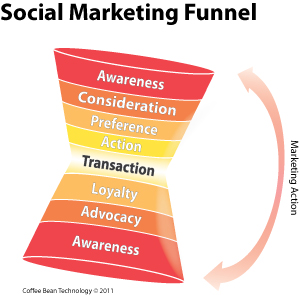
The role of marketing doesn’t end in Loyalty. Turning happy customers into Brand Advocates and then amplifying their voice is how marketing creates more awareness and brings new prospects to the funnel.
Your opinions, please.
[see very active discussion]

This morning, my friend Alan Berkson (@berkson0) was at the ball park, announcing it live to the world through Twitter:
When you can actually count the number of fans in the stadium its not a big number #mets
Then, he was waiting in line to buy lunch. The line was long and, to provide better service, they opened a second station and broke the line in half. Good for everyone.
But Alan was half way through and suddenly found himself back at the end of a shorter line. The guy who arrive right after him was now first in the second line.
I followed the situation unraveling from my desk at work, until I saw this:
Rep turned #custserv #fail into #succeed at #citifield #shakeshack=free lunch. FTW.
The intention of the service provider was to feed hungry people faster, but after the action they had a bunch of unhappy customers who before were about half way through the wait and were suddenly the last ones in line.
Is fairness (as perceived by customers) important as a metric of quality for customer service? The consensus in the Twitter discussion that followed is a big “yes”. Inconsistency translates into customer dissatisfaction.
If you are going to treat customers differently, it better be because of a tangible criteria (SLA’s, tiered services, etc).
Karina (@KarinaHowell) added that not only it is important to maintain service consistency from interaction to interaction, but also, and perhaps more important, across the multiple channels where service is dispensed.
This is a big source of perceived unfairness, with people who complain in public getting more attention than the ones calling the customer service phone lines.
As more of customer server traffic moves from phone to email to social media, companies will need to ensure consistency across channels, or have to provide free lunch to unhappy customers who find themselves at the end of the line.
 Simple things are the most important, people and culture is where your focus should be.
From the e20conf website: “Enterprise 2.0 is the term for the technologies and business practices that liberate the workforce from the constraints of legacy communication and productivity tools like email”.
These are tools that move us from message-based (e.g. email) and file sharing (e.g. SharePoint) communication to real-time interaction. They move us from hierarchical communication (data flows upstream and come back next month in a report) to horizontal, peer-to-peer collaboration.
Great advances have been made in the past years. Tools and techniques that first emerged in consumer social media are now been applied to improve corporate communications. It is becoming more common to see web 2.0 technologies deployed in our offices, we now can “follow” our co-workers.
But here is something very enlightening: Coffee Bean is a small but global company, we have people working in three different locations. As any organization, we have situations where communication doesn’t work as expected and misunderstanding happens.
The best tools and technologies cannot truly promote completely frictionless flow of information. Not even co-location can. And the reason is simple: people. We are complex machines that are not always completely objective and when we organize ourselves to try to tackle a complex problem, it is sometimes hard to get us all aligned.
We had one of those occurrences recently and Rodrigo, our CTO suggested we installed an “inter-dimensional window” between our offices. That is nothing more than a set of cameras/screens in each office connected through Skype. They are not to allow video conferencing (which we already do all the time), but just to allow people in one office to see what is going on in the other office through a panoramic view, as if the offices where physically connected.
That simple window has the effect of connecting the two environments in subtle ways. We can see when someone is at their desk or left for lunch, we see them arriving and leaving. We can occasionally wave and smile through that window.
Even in its limitations (and perhaps because of that), the inter-dimensional window is a powerful reminder that mutual trust is essential for collaboration and that we cannot judge what we don’t know.
Though the inter-dimensional window is a piece of technology, it is a reminder that the most important aspect of implementing a culture of collaboration is not in tools and technology, but in your most important asset: people and their culture.

We hear Social Media demands “personal” engagement. How can personal engagement scale? Isn’t that exactly why we moved to a statistical marketing model in the first place? How is Social Media going to help?
Let’s try to answer that question.
While the monthly e-mail newsletter may still be applicable in some cases, Social Media create new possibilities of soft engagement that can be less intrusive and more sensitive to customer interest.
Nurturing a social media community involves people having real and meaningful interactions. Other than the occasional company-sponsored golf outing, traditional marketing stay away from personal interactions and focus on automated statistical methods because engagement is difficult to scale in traditional media.
The promise of social media is to scale personal engagement.
Because social media is open, customer can initiate an interaction. They can follow the company Twitter channel, or comment in the company blog, or share a link to content in the website, or complain about a product in social media. Each of those actions create the opportunity for a personal interaction, a small dialog that happens over the action.
So, yes, the company needs to assign people and resources to monitor conversations in social media and react to it, be it by thanking for an action, fixing a problem, or participating in a discussion.
How does that scale?
After a first transaction, the work of traditional marketing was to pursue Customer Loyalty. In the Social Business era, companies need to strive to turn happy customers in Brand Advocates and cultivate the direct channels to let them influence others. Rather than publishing glossy Case Studies, you can directly connect your happy customers to your prospects in much more authentic and transparent interaction.

The success of a marketing campaign depends on find an effective way to reach our audience effectively.
Traditionally, segmentation is provided by media companies or result of analysis of information in the company contact database. To target a bride with wedding-related product, I would advertise in or run a joint campaign with a vertical publication, say, “New Bride Magazine”. Or I can query my customer database trying to find good targets based on data attributes (geography, industry segment, engagement level, etc).
In social media, companies can gather more information to customize messages based on the interactions over a long-term engagement. But there are limits on our ability to scale personal engagement at that level. Segmentation based on static analysis remains important.
Social Networks know a lot about its members. For example, Facebook and Google can help you to segment through targeted advertising or by letting you peek into the demographics or behavioral patterns of users. The audience also segment itself by congregating around LinkedIn discussion groups, making their personal profiles available, or using Twitter hash tags, for example.
Just because there are several social channels available to you, that doesn’t mean you will push every campaign through all of them. Who are you trying to reach? What actions do you want to trigger?
Here are a few factors for campaign segmentation:

 Marcio Saito