Great Product earns Loyalty, Great Service earns Customer Advocacy


[tweetmeme source=”Marcio_saito” only_single=false]

I have for some time been thinking and writing that the goal of companies must shift from Customer Loyalty (happy customers reliably come back for more)  to Customer Advocacy (happy customers tell their peers about how good your company is).

Loyalty and Advocacy sometimes come together, but they are not the same.

We are loyal to companies that are exceptionally good at satisfying a vector of satisfaction (value, flexibility, convenience, etc) we are sensitive to.

Airlines have been very successful implementing loyalty programs. Elite travelers get reward travel and can skip some of the terrible customer experiences airlines offer to their “regular” customers. It works. Most Elite travellers I know do unthinkable things to fly with their “preferred” airline.

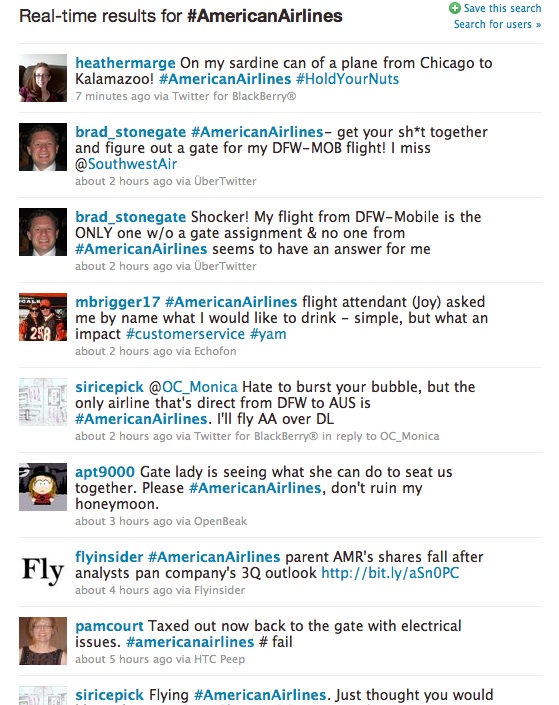
Now, search any of the airlines in Twitter and most of what you see are complaints from customers when things go wrong. Don’t expect to see customers taking the time to say “my flight on American today was wonderful, the service was so nice. I really recommend it”.

Random Sample at the time of this writing

So, how to earn Customer Advocacy?

Of course a great product and a prestigious brand help. But it is not enough. Is it Customer Service (as suggested by the title of this post) the key to earning Customer Advocacy?

When I posted “Great Products earns Customer Loyalty, Great Customer Service earns Customer Advocacy” yesterday during a Customer Service Twitter chat (Tuesdays, 6PM Pacific at #custserv) there was good reaction.

One of the comments I got back was “It’s the whole of the corporate community that earns advocacy.” (@MissusP @c7Group)

That is certainly true, the Social Customer looks at a positive and seamless engagement before putting their reputation behind a peer recommendation. Prestige of the brand and coolness of the products, value and purchasing experience, responsiveness when things go wrong, transparency and the respect for the customer voice, those are all factors.

If in the past the focus on customer engagement was on pre-transaction (branding, advertisement, sales), that has now to extend throughout the post-transaction experience.

So, it is not only about Customer Service. But that is where the revolution needs to start. Companies need to see Customer Service as their point of engagement with the Social Marketing Funnel. Customer Service has to get the same status within organizations as R&D, Marketing and Sales and stop being seen exclusively as a cost center.

If not the only key area, Customer Service is the glue that brings together the seamless customer experience that promotes Customer Advocacy.

Social CRM Use Cases for SMB [Expanded]


[tweetmeme source=”Marcio_saito” only_single=false]

As a leader in a small or mid-sized company, you are focused on running and growing the business. Any action and investment in process or tools needs to have a direct impact on the bottom line.

At the same time, you have heard about how business is changing (1) as a result of the adoption of social technologies and the emergence of the “Digital Generation” as consumers and business decision makers.

Customer Relationship Management (CRM) is evolving towards Social CRM in response to those changes. But how is Social CRM different from classic CRM? How can it help to increase the performance of my company? Is Social CRM only for the enterprise? How does Social Media affect my business?

As a business leader, you know transition is going to take years to complete. We acknowledge that as well but will present the case that the time to invest the time to research and find the right partners for the journey ahead is now.

Social CRM is the future of CRM

CRM is a set of processes (and associated tools) meant to manage the relationships of a company with their customers. It affects more directly the areas interacting with external partners and customers (typically sales, marketing, customer service).

Social CRM seeks to address the same scope of problems as Classic CRM.

Why do we need a new name for the same solution? Because there are significant changes in the business environment and CRM is evolving in response to them. Until that evolution consolidates, “Social CRM” is the future of CRM.

But what are those changes?

  • Changes in the business environment. Customers have gained access to information through the Internet. They connect and interact with their peers,  and are empowered and in control.
  • Emergence of New Technology. In the past decade social technologies have decreased the friction and cost of collaboration.  The adoption of those technologies by businesses promises to scale personal touch and change engagement with customers.
  • Generational changes. The digital generation born after the 1980’s grew up using the Internet and are now consumers and workers. They operate differently than most of the business leaders and will force companies to adapt.

If you see those changes driving business in the next decade and agree that they will require adaptation in processes and tools, read on.

What is the “Social” in Social CRM?

CRM has excelled in capturing the transactional aspects of a company operation (e.g. contact information, lead and opportunity data), enforcing and automating process to obtain quality (e.g. workflows, reminders and events), and providing management visibility (reports, dashboards).

But Classical CRM has not been very successful in helping sales and customer service representatives in customer engagement. Sales people will tell you how CRM feels like a chore instead of a tool most of the time.

Why is that?

The “last mile” of customer engagement has always been social. You have heard this before: “Sales is based on relationship”. ”People buy from people”.  “The most important factor in a buy decision is peer recommendation”. The sales process is not linear  and cannot be captured in a linear workflow.

Business have already recognized that by, for example, building Customer Cases as a mechanism of peer-influence and using business lunches or golf outings to establish personal relationships. But those are expensive and hard to scalable methods.

Classical CRM tools are built around databases, form and workflows. Those are excellent technologies to model structured processes. But they cannot effectively model conversations and relationships.

Social CRM tools leverage Social technologies (sometimes referred to as Web 2.0) and techniques that emerged first on the consumer web and promise to help scale human touch so that companies can better engage with customers and provide a seamless and satisfying customer experience.

The same techniques can also be used to promote internal communication and collaboration so that customers see one company and have a seamless experience even if their point of contact moves across different departments over their life cycles.

The Use Cases for Social CRM in SMB

CRM is both about the processes and tools. For an in-depth exploration of Social CRM methodologies, we recommend the book “CRM at the speed of Light” (2) by Paul Greenberg.

The market reference for selection of  Social CRM tools is Altimeter Group’s report “The 18 use cases of Social CRM” (3), which is freely available as a reference. Here we will focus on the ones that most immediately relevant to small and medium-sized companies.

Social CRM intends to solve all problems currently addressed by Classic CRM tools, but it also leverage social technologies to better address certain use cases.

1.     Sales and Marketing Insights

With traditional media, companies can broadcast their message (publish papers, post advertisement, etc) but listening is really difficult. Corporations have been using anecdotal face-to-face interactions and tools such as surveys, focus groups, customer advisory boards to collect market input.

Social CRM tools leverage social media to allow companies to listen to what their customers, prospects, partners, competitors are already publishing.

Most business people have a LinkedIn profile and that is the first place they announce any change in their job status. Many also post updates about their current activities and interests on social networks such as Facebook or Twitter.

If, for example, you sell IT equipment and your contact at BigCompany announces a promotion to VP of  Data Center Infrastructure on LinkedIn, that is probably the time for you to call her both to congratulate on the job promotion and learn about her plans in the new role.

News about the your business customers are available both from their own social media presence, as well as from industry news sources.

You probably don’t need to follow every news item for every customer, but you do want to know about certain events (change in management, merges and acquisitions, opening of new offices, etc) that might trigger an action from you.  On the other hand, right before you pick up the phone, you want to know what are the most current announcements of any kind related to both the company and person you are calling.

Social CRM tools actively connect to Internet resources (be it LinkedIn, Google Maps, Twitter, company websites, news sources) to bring you sales and marketing insights when you need it and in the context of you business operation.

So it is not about spend all day watching Twitter or Facebook feeds, but having a system that brings that information at the right time, in context of the business task so that social information is an empowering tool, not a distraction.

2.     Social Media Monitoring and Social Lead Generation

Traditional methods of lead generation rely on broadcasting to a large list compiled by and rented from media companies and hoping that a very small number reacts to it and become leads.

That statistical reliance on serendipity (catching the “suspect” at the exact time she is sensitive to the message) is not enough and cannot sustain a medium-sized business in a competitive space.

The new “funnel” is not in static lists, but in online communities, where prospects can give out the signals of readiness without depending on statistical luck. Social CRM tools allow the monitoring of those social venues and detect the exact right time (both for the seller and the buyer) to establish sales contact.

As an experiment, if you have not yet tried Twitter yet, go to the their site and type the name of your company (or another well-known company, maybe the leader in the space you are in) in the search box. Spend a couple of minutes studying the results. If you are lucky, you will see posts from users that look like this “Hi, I am considering buying the X solution from BigCompany but looking for alternatives. Any suggestions?”.

Don’t you think that looks like a lead? With Social CRM, you don’t need to be lucky, the tool will help you to engage with the relevant communities so that you don’t miss those “signals of readiness”.

3.     Customer Advocacy and Social Customer Service

Any sales person know that one of the most powerful tools to convince prospects are credible case studies. Marketers have studied it. Psychologists have studied it. They all agree. People feel more comfortable buying what their peers are buying.

Why is it that companies are always struggling to get happy reference customers to influence their peers? Why do we bring contracts and non-disclosures into that process? Because companies would like to control that peer-to-peer influence.

Social CRM tools assume customers empowered by the Internet will connect and communicate with their peers whether we like it or not. If we cannot control, we better at least participate in the conversation.

Social CRM tools help you to connect happy customers so that they can influence, help, and nurture each other. They also connect you with unhappy customers, so that you can react fast and make it right.  Satisfaction surveys are no longer enough, you need to detect and fix problems in real time, so that you make your customer happy before they start talking to peers about the bad experience.

Leveraging Social CRM tools for real-time response will require changes in the culture of companies, with increased openness and transparency. But the benefits are rewarding.

4.     Internal Collaboration

Companies have increasingly segmented work to achieve efficiency. We have been taught that the best way to run a business is to break big tasks into “independent” smaller ones until they can be assigned to functional areas and people and tied to an MBO scheme.

For example: Marketing broadcast messages and capture leads, Sales close deals and capture revenues, Customer Service deal with after-purchase issues.

Two side-effects of excessive segmentation are that the company does not offer a consistent customer experience (which affects its competitiveness) and many opportunities are lost for lack of engagement. If we believe peer recommendation is a major source of leads and purchase influence, then marketing, sales and customer service should be tightly integrated.

Segmentation can work relatively well in some environments, and has worked particularly well in sales, but we have seen many deals lost for lack of it. Social tools lower the cost of collaboration and enable people to work together without losing efficiency, but gaining in effectiveness.

Product Managers and Customer Service representatives know things that can make or break a deal. Look at your organization. Does information flow well between functional areas? When I prepare to call a contact, I would like to have new marketing information from product management, upcoming software updates from engineering, status of customer service calls all on my screen so that I can provide the best possible service to my customer.

Does that happen in a typical organization, even small ones? No.

Social CRM tools bridge the gaps between functional areas. This is not about deploying SharePoint and hoping people will browse static file repositories. It is about bringing the right up-to-date information to the right person when it is needed and in context. That is usually done using a collaborative platform that leverages the use of intelligent information Streams.

Conclusion

The shift from Classic CRM to Social CRM will happen over the next several years. But the time to invest in research and select the right partners for the journey ahead is now.

If we convinced you of that, we hope you will share this information with others and consider partnering with Coffee Bean Technology.

As mentioned before, Social CRM is the evolution of CRM and no vendor has the perfect solution for everyone.  We believe the use cases above can serve as a good starting point for you to look at what your current CRM tool lacks and what each vendor can offer.


Augmented Customer Relationship


Are tools supposed to guide or assist?[tweetmeme source=”Marcio_saito” only_single=false]

You most likely have used a GPS device to guide you from point A to point B. You also know that your GPS system has a Point-of-Interest (POI) feature that allows you to locate gas stations along the way and insert them as waypoints in your route.

You have never used POIs to find gas stations. And you never will.

Why is that? Humans are not good driving to a place they don’t know, but they are very good at finding gas stations along the way. That is because we can search them visually (we are much better than machines at that) and use patterns such as “there is usually a gas station on freeway exits”. The GPS POI software does not provide enough value to justify itself for that task.

The “Relationship” in CRM Tools is like the GPS Point-of-Interest

If your company has more than a handful of people in sales, you have a CRM system which is used, among other things, to store contact and transactional information and provide reports and dashboards to management. You know your CRM tool was also designed to enforce sales processes and help sales people sell. And, as you probably know, they don’t use those features for real.

Like looking for a suitable gas station, Sales is a human, non-structured activity and it is impossible to capture the relationship aspect of it into a linear workflow. If the CRM system forces you into a fixed process, you just stop using it.

Does that mean CRM Tools cannot help people to sell?

Of course they could, but it takes a different approach. For activities that are not suitable for automation, systems should not attempt to guide through a pre-established path or workflow, but  instead it should assist by bringing meaningful data in context that enhances their ability to make decisions on the fly.

Augmented Reality is an emerging technology that overlays a data layer over what you see to assist you in making faster decisions. Imagine that as you drive, your car can detect sources of infrared and project on the windshield so that it highlights a deer crossing the road in front of you. It is still up to you to avoid hitting the animal, but the system is providing information to assist your actions.

When it comes to Sales, CRM should assist, not guide

If CRM systems can refrain from guiding people through a rigid sales process and rather project a data layer on the windshield that brings information in context so that humans can make better and faster decisions, maybe we can get the right combination of guidance and assistance that makes CRM software not only good at storing contacts, capturing transactional data and providing analytical reports, but actually help you to find more gas stations.

That is one of the promises of Social CRM.

Customers Want to Spread the Good News


Is Customer Service the new Public Relations?

[tweetmeme source=”Marcio_saito” only_single=false]


At the recent CRM Evolution conference, several of the speakers developed the concept that “Customer Service is the new Public Relations” (several others have written about it as well). Broadcasting your messages before and then listening only after the sale is no longer an appropriate segmentation. Companies need to provide a seamless customer experience, integrate the PR and CS efforts, and engage with customers from the beginning of the relationship.

I like that concept and have been pondering on it. It seems to be obviously the right thing to do. What are the obstacles for that to be implemented in real life?

Business People still afraid customers only complain

I asked a friend who owns a company reselling IT equipment (B2B) about her thoughts on tearing down the silos and segmentation in the customer interface. She tells me that there is too much risk customers and prospects would share sensitive information (such as price discount levels) and gain leverage against her or negatively influence other prospects (for example, by sharing limitations or deployment challenges for a specific solution).

“But wouldn’t the upside offset those risks?” I asked. She said  “when things work, customers go back to their business. They are too busy to share the good news. Customers only talk when there are problems.”

Whether we agree or not, I don’t think she is alone in that thinking. Companies are aware of the power of customer advocacy and want to capture Case Studies in paper, but they hesitate in promoting and amplifying peer-to-peer interaction among the customer and prospect bases for fear they will share bad news.

Customers are positive and like to spread good news

Then a few days ago, my friend Munish Gandhi (@munishgandhi) shared a link to a recent Customer Service survey by American Express Barometer.

Importantly, customers are spreading the word willingly and widely when they experience good service. In fact, contrary to conventional wisdom, customers are more inclined to talk about a positive experience than complain about a negative one. Three-quarters (75%) are very likely to speak positively about a company after a good service experience in contrast with 59% who are very likely to speak negatively about a company after poor service.

So customers are more likely to talk about positive experiences than to complain about negative ones. Those results are in line with several other studies and surveys that conclude that people naturally tend to be positive/optimistic in average.

Breaking the silos

Why the disconnect between perceptions and reality? I believe the source of the bias is that the negative experiences in customer service tend to escalate up the management chain and gain visibility within organizations. When customers are happy, the classical company ignores them (and lose the opportunity to leverage customer advocacy – a fundamental aspect of Social Business). That is a problem in company attention focus, not in customer behavior.

Before we can accept the elimination of customer interaction silos so that Customer Service can be the new Public Relations and vice-versa, companies must acknowledge that the new social customer shares information with their peers whether we promote that conversation or not.

We also need to join the optimistic majority and believe that there is more upside than downside in promoting peer-to-peer customer interaction and amplifying the resulting conversation.

Customers want to spread the good news. We need to let them do it freely.

So, Companies, tear down that wall.

The Twitterfeed is Dead


Twitter is transport more than interaction tool

[tweetmeme source=”Marcio_saito” only_single=false]

When Wired Magazine recently declared on its cover “The web is dead“, it really meant that the Internet is becoming primarily a transport infrastructure and that applications (be it an iPhone app or a web 2.0 widget) running on the client will use it to communicate with servers in the cloud.  The model of a central server serving static user interface pages and action buttons to a browser that does not leverage local computing power is dying.

That is not new. In the 1980’s we shifted from mainframes computers to client-server architectures. Same evolution, same pattern. Can that be the case for micro blogging as well?

There is no question that the emergence of Twitter is  an incredible development. While the majority of the Internet users are still not there, those who are tend to become intense users quickly.

Twitter users are getting tired

People have debated the 140-character limitation endlessly. That feature made it primarily a transport infrastructure. Most of the posts in my timeline are a headline and a link to content stored outside Twitter.

As users connect to more than 75 other users or so, they can no longer keep up with their Twitter timeline. As marketers hijack popular hashtags, it becomes difficult to see the big picture of a discussion without spending unjustifiable amount of time separating signal from noise.

It is true that the Social Media communication protocol is recipient-discretion and nobody should feel pressured to read everything that passes the screen, but I see (and feel) signs of tiredness.

But Twitter still can be incredibly useful as a social transport

Change is coming. As we discover that transport infrastructures such as the Internet and Twitter are generally useful for different applications, creative people find ways to use it. Most intense users of Twitter are now using tools such as HootSuite or TweetDeck to help visualize posts of interest. A single-threaded timeline is no longer viable.

A new generation of applications are now using Twitter transport to add new features to specialized applications (be it Social CRM, Customer Service, Movie Reviews…). Filtering technology (social or algorithmic) can be applied. Timelines can be brought into the context where work is being done so it becomes a tool, not a distraction.

In the past days, we saw a deluge of posts announcing that “the xxx daily is out at Paper.li”. Aggregating micro blogging posts using a newspaper metaphor sounds like a step backwards or a bridge: if you are old-style and cannot keep up with Twitter, we will package them in old-style newspaper format for you. Reading glasses not provided.

But, as I look at my paper.li page (which aggregates posts from people I follow), I realize it is a darn good way of getting the big picture without having to watch a time line all day. Sure, it is using Twitter as transport and leveraging the effects of social media, but it is delivering a different user experience.

All I am saying is that it is becoming obvious that the Twitter is just a transport. The killer app for interacting with that transport is still to emerge. Things like HootSuite and Paper.li are just the beginning.

The Twitterfeed is already dead and I had not noticed.

Long life Twitter Transport.

Where are the Early Adopters of Social CRM?


It is time to shift from Ideas to Execution – where does the path start?

[tweetmeme source=”Marcio_saito” only_single=false]

Even if you haven’t heard much about Social CRM, you know customers are empowered by the use of digital technology and changing the way they engage with vendors. Social CRM is the answer to that change.

If you are in the SCRM community, you have heard the call for analysts, vendors and other experts to move from discussion of terminology and ideas to execution.

The shift to Social CRM (“Social” being a temporary terminology differentiator until CRM is social) has started several years ago and will continue to unfold for several years ahead. Turning customer relationships upside-down is a revolutionary idea, but business execution, processes and tools take longer to evolve. We are just starting that journey.

If you are still with me, I think a good question to ask is “Where is Social CRM first going to get traction?” If the transition is going to happen over a long period of time, it is reasonable to expect the adoption of Social Technologies will happen based on the path of least resistance and larger return. What specific business verticals are the low-hanging fruit ripen for early adoption?

I don’t have the answers, but I here are some ideas (which are admittedly not complete) :

The Medium is the Message

Of course the first companies affected by the emergence of Social Computing and the availability of the Digital Medium were the Media company themselves. Music, Press, Publications, Software industries are quickly being transformed by the use of Social Media. Incumbents did not it coming and are now struggling to adapt or becoming casualties of the the change.

Consumers are Faster than Businesses

Similarly to e-mail adoption in the early 90’s, the consumer has embraced social media earlier and faster than most businesses, so companies in the B2C space have already embraced Social Computing and are aggressively leveraging Social Media to listen and reach the market.

If B2C is past early adoption, what about B2B Social CRM?

Because business have not yet fully embraced Social Media for external communication and Social Computing tools in their internal operation, it is natural to expect the adoption of Social CRM to be gradual and selective.

Business selling B2B products or services for which early adopters of Social Media within the customer organization are also the buy decision makers should be able to implement Social CRM effectively earlier.

If it is true that Social CRM reflects a shift of control towards the customer and that Social Channels is the best way to scale the new customer engagement, then for Social CRM to work in practice, customers need to be able and willing to engage in those social media channels.

As an example, in most companies, marketers are the first to be exposed to social media and are likely to be early adopters of it both as a channel for marketing as well as a tool for everyday work. So, businesses selling to marketers like Marketing Agencies, Media Companies, Consulting Firms are natural early adopters of Social CRM in their practices.

Business selling B2B solutions that already have segmented Social CRM Practices can consolidate customer engagement and leverage newer Social Media channels.

Many companies selling complex solutions already have Social CRM practices partially implemented in certain areas. For example, it is not uncommon for Enterprise Software vendors to handle their post-sales customer service through online forums, communities and Knowledge Base systems (though still primarily using traditional broadcast methods to engage with customers pre-sales).

Because they already have some in-house experience listening to customers, their Social CRM adoption can focus on unifying their pre- and post-sales practices and shifting their technology infrastructure to better leverage open public social media channels.

Business selling B2B products or services for which focused, cross-vendor online customer communities have already developed naturally

Most IT vendors already maintain some type of branded customer community. But most of the interaction among IT System Administrators happen in cross-vendor open communities without control by a particular vendor.

There are many other instances of the example above and business selling those types of products or services should be able to benefit from and justify the adoption of Social CRM practices and tools.

Businesses selling B2B products or services for which opportunity or action triggers are often directly present in Social Channels.

Business travelers are circumstantially inclined to express frustration online, so any company providing relates services (hospitality, transportation, etc) are likely to benefit from adopting technologies that allows them to react in real-time.

There are incentives and psychological rewards for works to quickly announce job changes and promotions (by updating their LinkedIn profile, for example). The same apply to business announcements of changes in management, M&A activity and opening of new branches or locations. Business for which those events represent a significant trigger for action or opportunity can probably get disproportionate return on investments in Social CRM. Recruiting firms, IT equipment vendors are examples that come to mind.

This article was originally written for and posted at http://www.theclickcompany.com

Making Caipirinha


Some of my friends will engage in long discussions on what is “the” recipe and process to make a “real” Caipirinha, but the traditional Brazilian cocktail is really really simple.

The word caipirinha translates to “country girl”, but that doesn’t carry much meaning. Caipirinha is really the name of the drink. It is a refreshing cocktail that can be found anywhere in Brazil and in bars around the world.

It is made from Cachaça (a.k.a. “Pinga”), a clear or slightly golden distilled from fermented sugar cane typical from Brazil. It is similar, but different, from rum (which is distilled from molasses). Popular and readily available brands include “51”, “Pitú”and “Ypioca”. In the US market “Sagatiba”, and “Leblon” are the most common.

Most cachaça is produced in high volume and intended to be mixed or to be taken as a shot. There is higher-quality cachaça meant to be sipped straight,  but you need to have a Brazilian friend to find one.

Here is my Caipirinha recipe (for two):

  • 2 small-to-medium limes
  • 4 teaspoons of sugar
  • 4 ounces of Cachaça
  • ice

Look for limes with smooth and thin skin. Wash, trim the top and bottom off, cut them in wedges or 1/8s. Add the sugar and mash with a muddler. Add the Cachaça. Shake the mixture and serve in a old-fashioned heavy glass with crushed ice.

Variations include the use of Vodka instead of Cachaça or the addition of other fruit juices (in which case, Brazilians call it “Batida”).

Here are a few examples of cachaça you will find in my pantry.

So, what is “Meritage”?


[tweetmeme source=”Marcio_saito” only_single=false]

So we have another of our wine tasting dinners this weekend. Our theme this month is “Unusual Blend.”

In the Old World, most wines are classic blends of different grapes. There are baseline proportions, but the wine maker will adjust the exact amount of each grape based on the characteristics of the harvest each year (with the purpose of maintaining balance and expressing the character of the local weather and soil conditions – the terroir). Wines are labeled based on the region where it is produced, following the classic local blend.

For example, Bordeaux is a region in the Southwest of France producing both white and red wines. Red wines are produced as a blend of Cabernet Sauvignon, Merlot and Cabernet Franc grapes (sometimes with the addition of a small proportion of Malbec and Carmenere).

Rioja is a region in Northern Spain. The Red Riojas are made mostly of Tempranillo (60%) and Granacha (20%), with smaller proportions of Graciano and Mazuelo grapes.

The better climate conditions in the wine producing regions of the New World allow wine makers to produce wines from a single grape varietal (searching to maximize the potential and express the character of the grape and the region). Accordingly, wines are labelled based on the varietal and region (Napa Valley Cabernet Sauvignon, Russian River Pinot Noir, etc).

So, California is generally known for its Cabernet Sauvignon. The Santa Cruz Mountains leverages the local micro-climate to product great Pinot Noirs. Australia wine regions produce lots of Shiraz.

Some grapes that were originally used in Europe only as a minor component of classic blends have been expressed in single-varietals in the New World. Argentina produces world class Malbecs and Chile produces Carmenere, for example.

When blends are produced outside the traditional regions in Europe, they cannot carry the original region name, which are protected by a international regulatory system.

In the US, wines must contain at least 75% of a grape to be labeled as that varietal, so Bordeaux-like blends do not qualify as a varietal and there was growing frustration among wine makers with a generic “red wine” label.

So in 1988, the Meritage association was created to manage a newly created trademark to designate those blends made from grapes traditional from Bordeaux in California (membership has since grown to include some other international wines).

Engaging with the Social Customer


[tweetmeme source=”Marcio_saito” only_single=false]

Everyone Represents the Company

Social Business Series (V)

The articles in this Social Business Series are being written for real-life SMB Leaders, who are busy running their business and have not had the time to read everything  in the emerging Social-anything space.

We have explored the scope of Social Business Software, the Use Cases for Social CRMSocial Lead Generation and Marketing Funnel, and Leadership in Social Business.

Let’s now focus on the specifics of Customer Engagement. If you would like to know more about the ideas behind the new “Social Customer”, you can check our The Click Company booklet or Engage, a book by Brian Solis.

Customer Service is the new Public Relations and vice-versa

We have segmented companies in departments dedicated to broadcast to or “influence” customers before the sale and others to listen to or “handle” customer problems after the sale. That segmentation optimizes organizations for efficiency, but does not provide for a seamless and satisfactory experience throughout the customer life-cycle: prospect, buyer, satisfied and loyal customer, brand advocate.

In the Social Business era,  the Social Customer will demand a better experience. The person representing the company in any customer interaction must be empowered to answer a question, solve a problem, collect feedback and satisfy a need on the spot.

Being able to communicate across multiple channels is no longer enough, you must be capable to switch between channels without losing context or dropping the ball.

This change will stress current business models and require changes in how we engage with prospects and customers.

8 points to consider when evaluating Customer Engagement in SMB

Only you know what applies to and works for your business, but here are a few points to consider when re-evaluating the way your company engage with customers.

  • Speak like a Person! Customers can see through the marketing messages and detect the intentions behind them.  Communicate as openly and directly as possible.
  • Recognize the true value of relationships. How much is a relationship worth? It is the sum of the transactions, plus the co-creation value (product and marketing insights), plus all the other transaction influenced by the person over the life of the relationship. Don’t think about the size of the deal, but how much value the person brings to the company.
  • You must go where customers are. For business customers, it can be online forums ( if you are lucky, your own online community) but they are starting to use social media sites for business as well. Employ Social tools embedded in your CRM or Customer Service platforms to scale human relationships. Automation is good for back-end processes, not for customer relationship.
  • Own the Engagement. Outsourcing Customer Service? Considering an “indirect channel strategy”? Thinking of your resellers as the real customers because they are the ones buying from you? Having other entities interact on your behalf is fine, but you need to own the engagement with customers, or your competitor will.
  • Open your Knowledge Base. Your KB must be open to external contributions and accessible so that customers can self- and peer-help, saving your resources to deal with the instances where specific action is required. The social customer often knows more about the product than the vendor itself.
  • Open your product design process to include customers. I don’t mean just having a product manager collecting use cases from anecdotal customer interactions. I mean truly open the process using social computing technology if necessary so that customer can help to co-create the solution, offer suggestions, prioritize features in a continuous and iterative engagement.
  • Operate in Real-time. If a customer is unhappy, you want to know immediately, before she influences 10 other prospects. A happy customer becomes a brand advocate.
  • Turn Marketing into a Resonance Chamber. We already know that the best way to convince a prospect is to have the endorsement of a happy customer. Connect your happy customers with your prospects, be in the conversation and resonate/amplify it. That is the new role of marketing.


If you find this article useful, you can subscribe to the RSS feed for this blog and leave comments suggesting other topics.

Also in the Social Business Series:

This article was originally written for and posted at http://www.theclickcompany.com

Business Lessons from the Free Software Community


[tweetmeme source=”Marcio_saito” only_single=false]

Engineers have something to teach Business People

My involvement with Free and Open Source Software movement in the early 90’s is the root of the interest for Social Computing that brought me to Social Business/Social CRM. That was the first time a large group of people leveraged the pervasiveness of the Internet to collaborate in large-scale across traditional borders.

Several of the thought leaders in Social Computing were also involved in the Open Source movement (e.g. Doc Searls, proponent of VRM, was – still is –  an editor at the Linux Journal when he wrote some of the essays in the Cluetrain Manifesto more than ten years ago).

Developers all over the world voluntarily contributed time and content to community projects in exchange for peer-recognition, reputation and plain intellectual curiosity. Without any traditional organizational structure, Linux developers successfully tackled a very large structured problem (building an Operating System Kernel).

Linus Torvalds, the project leader, had no formal power or control over the developers.Marcelo Tosatti, the maintainer of the official Linux kernel distribution,  was 18 years old and worked from his bedroom in the South of Brazil, producing the software builds used to power the data centers of virtually all Wall Street financial firms.

The GNU/Linux Operating System runs most data center servers, including the ones at Google, Amazon, and JP Morgan. Databases like MySQL, Cassandra and Postgres are used to store data, including your bank transactions, Tweets and Status Updates. Development Tools such as Java and PHP powers almost all websites. If your browser is not Internet Explorer, it is built primarily on Open Source Software.

All this software was developed by communities of professional and non-professionals volunteers, working without direct financial interests or the control of a hierarchical structure. Some of the projects involved tens of thousands of people distributed all over the world.

Can big problems outside software development be solved the same way? That is up to debate, but here are some lessons engineers can offer to business people.

  • Hierarchy, structure and process may be useful, but they are not the only way to coordinate a large number of people in tackling a complex problem. Communities of volunteers with minimal coordination can achieve comparable results.
  • Financial reward is powerful, but it is not the only way to motivate smart people to contribute to a joint effort. Peer recognition, intellectual pride and curiosity and community reputation can be as or more powerful.
  • Collaboration may not be efficient, but it can be very effective in tackling problems that are broad in nature.
  • Community leadership emerges naturally and does not need to be associated to power and control mechanisms or a robust management system assigned by formal organizations.
  • Businesses can get involved with collaborative efforts without necessarily giving up their commercial interests or corrupting the community.

This article was originally written for and posted at http://www.theclickcompany.com